
October 2025
As we move through 2025, we’re excited to share perspectives on the trends and shifts in U.S. Early-Stage, Net New Enterprise Technology. We encourage you to explore our key insights below, along with notable updates from our portfolio companies and our research group.
View from the Top: Key Trends and Insights
AI Usage Surge
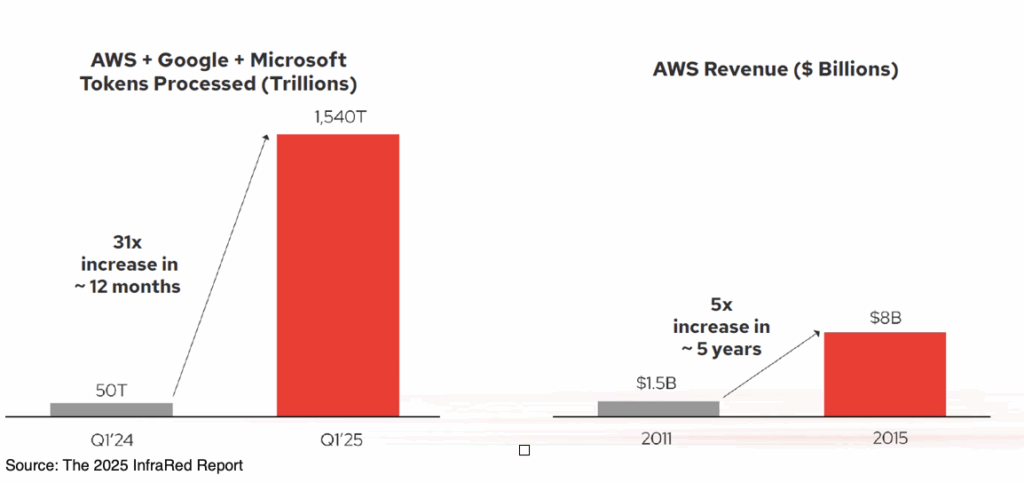
There is an explosive pace of growth in the AI infrastructure cycle compared to the earlier cloud computing wave. From Q1 2024 to Q1 2025, the combined tokens processed by AWS, Google, and Microsoft surged from 50 trillion to 1,540 trillion, a staggering 31x increase in just 12 months. By contrast, AWS revenue grew from $1.5 billion in 2011 to $8 billion in 2015, representing a more measured 5x increase over five years. The comparison makes clear that the AI cycle is scaling at a dramatically faster rate than cloud computing did in its early years, requiring an extraordinary amount of infrastructure buildout to sustain such momentum, an effort that underscores both the unprecedented opportunity and the immense operational challenge at hand.
Indexed Cost of LLM Inference vs AWS EC2
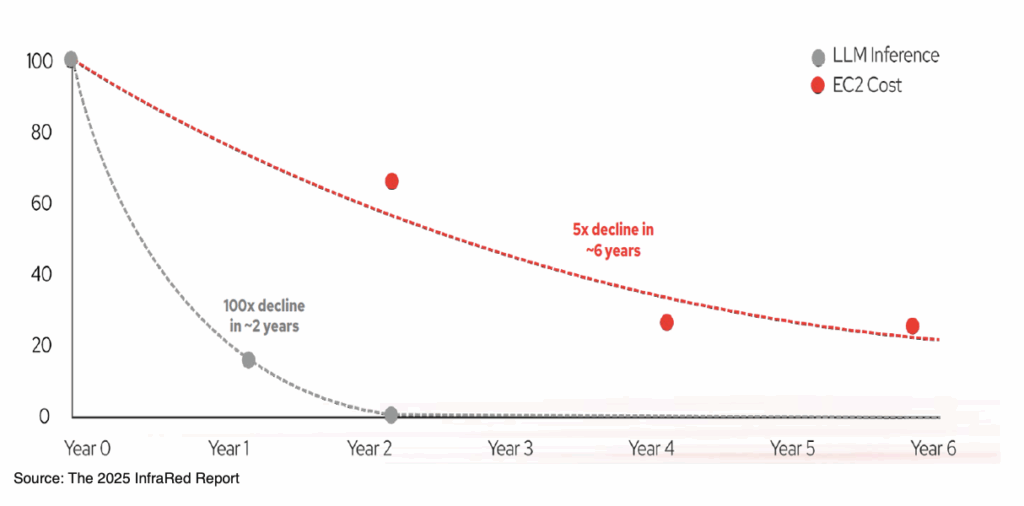
There is a dramatic decline in the indexed cost of LLM inference compared to AWS EC2 costs, highlighting the increasing leverage in infrastructure to deliver higher output at lower costs for AI. Within roughly two years, LLM inference costs fell by 100x, while EC2 costs declined at a steadier pace of about 5x over six years. This stark contrast underscores how quickly AI-specific infrastructure is becoming more efficient, enabling far greater scalability at significantly reduced expenses, resulting in an efficiency curve that is much steeper than traditional cloud compute improvements.
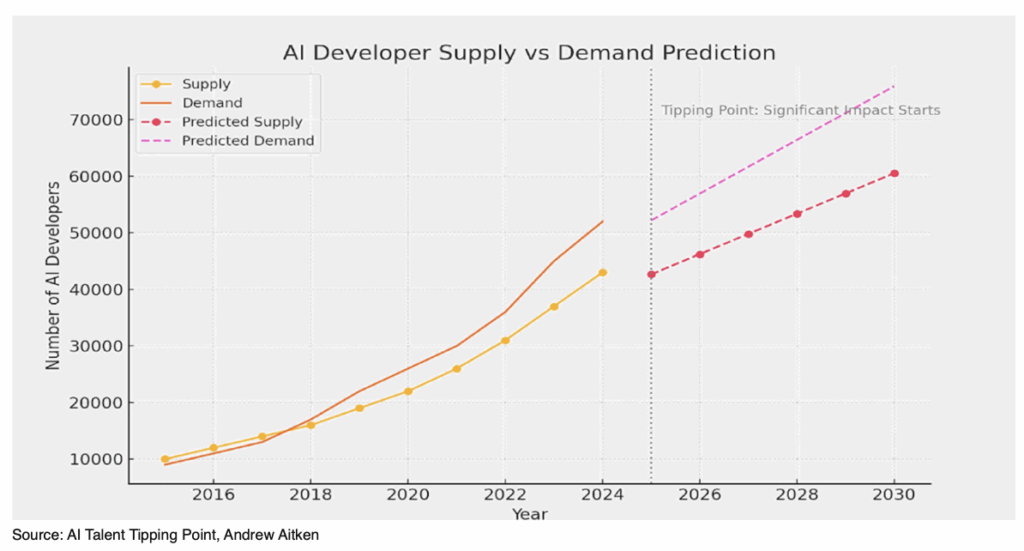
The chart illustrates the projected relationship between AI developer supply and demand from 2015 through 2030. From 2015-2024, both supply and demand rose steadily, with demand consistently outpacing supply and the gap widening over time. Projections for 2025-2030 suggest this imbalance will continue, with demand expected to surpass 75,000 AI developers by 2030, while supply will lag at around 60,000. The chart also highlights a “tipping point” around 2025, marking the beginning of a period where the shortage of AI talent is expected to have significant industry impact. Overall, this data underscores the growing structural gap between the demand for AI expertise and the available workforce.
Tech Layoffs by Employee and Company Count
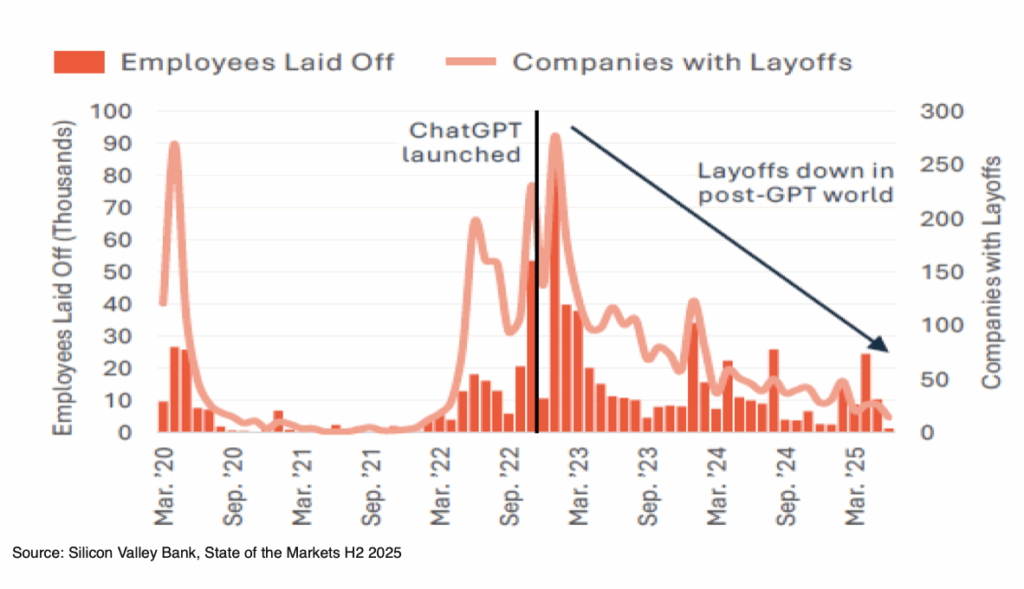
From March 2020 through March 2025, both the number of employees laid off and the number of companies conducting layoffs declined significantly after the launch of ChatGPT in late 2022. The pandemic initially drove massive job losses, followed by another surge in 2022–2023. Yet, the post-GPT era reflects a steady reduction in workforce cuts. This trend demonstrates that AI adoption thus far, has not replaced workers. More importantly, AI is not only preserving jobs but also fostering the creation of better opportunities across industries facing labor shortages. This shift supports higher-value, skill-oriented work and lays the foundation for sustainable economic growth and stronger long-term competitiveness.
Our Portfolio Company News
Several Cota portfolio companies have achieved notable milestones that we’re excited to share:
Tote.ai, an AI-native point-of-sale system for fuel and convenience stores, announced it has received $22.6 million in funding to accelerate hiring, market expansion, and product features. The round was led by Cota Capital. LEARN MORE
Upscale AI, a new high‑performance AI networking company, announced its launch with over $100 million in funding. The seed round was co-led by Mayfield and Maverick Silicon and included participation from StepStone Group, Celesta Capital, Xora, Qualcomm Ventures, Cota Capital, MVP Ventures, and Stanford University. LEARN MORE
Simbian, building Superintelligence for Accelerated Security, launched its AI Threat Hunt Agent, which integrates with theMicrosoft Sentinel data lake. This announcement enables Microsoft 365 E5 customers to accelerate and scale their organizations’ threat hunting capabilities. Simbian’s AI SOC Agent has also been extended to leverage the vast security data available in the Microsoft Sentinel data lake. LEARN MORE
Seraphic, a leader in enterprise browser security, and Akamai Technologies, the cybersecurity and cloud computing company that powers and protects businesses online, announced that they have signed a strategic agreement to offer a streamlined, cost-effective solution that combines enterprise browser technology with ZTNA. LEARN MORE
Farther, an intelligent wealth firm fusing proprietary technology with advisor expertise, has surpassed $13 billion in recruited assets, including AUM and assets onboarded from new advisors in the coming months. With these assets accounted for, Farther’s AUM is slated to nearly triple since the start of 2025. LEARN MORE
Qu, a leading unified commerce platform, announced the launch of Qu Business Edge — Qube for short. Qu’s edge-powered intelligence platform is designed to slash costs, boost check sizes, and speed up service. By fusing edge computing with embedded AI, Qu is redefining what modern restaurant infrastructure looks like. LEARN MORE
Our Latest Research Articles
A Practical Architecture for Intelligence at the Edge
In today’s fast-paced world, from warehouses to hospitals, critical decisions must happen instantly, right where the data is born. This article lays out a clear framework for how sensing, perception, local inference, and cloud-edge integration come together to power faster, smarter, and more resilient decisions. LEARN MORE
Thinking Outside the Grid: The Promise of AI in Engineering Solutions
Simulation is a critical yet complex stage in hardware development, demanding time, expertise, and computational power. This article highlights how physics-informed AI is set to transform the process— guiding design decisions, automating workflows, and reshaping the future of engineering. LEARN MORE
Illuminating the Black Box Through AI Observability
AI observability is a vital and fast-growing field for managing machine learning failures in production. This article identifies five key opportunities—data quality, performance, bias, explainability, and LLM-specific issues—and argues that AI-native startups are best positioned to build platforms that could define the next wave of enterprise software leaders. LEARN MORE
Why Digital Twins are the Future of Industrial Operations
Digital twin technology creates real-time virtual replicas of physical systems, enabling performance monitoring and predictive maintenance that transform operations. Driven by advances in IoT, connectivity, computing, and AI, digital twins are emerging as a catalyst for innovation and competitiveness. LEARN MORE
Designing the Future: How AI is Transforming Hardware Development- Part 1
Hardware development remains complex and labor-intensive, but breakthroughs in data, generative AI, and physics-informed models are set to accelerate the process—much like software engineering’s earlier transformation. LEARN MORE
Designing the Future: How AI is Transforming Hardware Development-Part 2
Part two of Designing the Future explores how AI-native platforms could transform hardware development by simplifying design, accelerating simulations, and automating pre-manufacturing—bringing software-like speed and agility to hardware. LEARN MORE
Share Story