by Behrooz Rezvani and Vikram Venkat
Physical AI has been in the news significantly recently… what is it, and how are the bigger players making moves in this space?
Physical AI is the shift from AI that operates in digital tokens – text, images, code – to AI that must perceive, reason, and act in the real world. In Physical AI, the system has to respect real-world constraints like geometry, motion, uncertainty, and physics. The consequence of error is also very different: if an LLM makes a mistake, you might get a bad summary; if a Physical AI system makes a mistake, a robot or vehicle may act unsafely.
A useful way to frame the difference is this: LLMs operate over a finite token vocabulary and learn distributions over discrete token sequences. The number of meaningful sequences is enormous, but the representation space is still symbolic and discrete. Physical AI is different: robots operate in a continuous world with effectively unbounded variation in pose, weather, lighting, materials, interference, occlusion, and human behavior. That means no matter how much data you collect, you cannot train on every scenario. The long tail is not just large; it is structurally unavoidable.
So, the next frontier is not only bigger models; it is world understanding: systems that can infer what is physically possible, what is causally consistent, and what is safe, even in situations they have never seen before.
That is why the bigger players are moving toward full-stack Physical AI platforms, not just larger models. NVIDIA’s recent moves in foundation models, simulation, and AV-focused VLA workflows are a good example. Tesla, in a different way, has pushed the industry to take fleet-scale deployment and software iteration seriously. Both trends are important.
But the industry is also converging on a key realization: a better brain does not solve bad sensing. If the inputs are noisy, unstable, or physically ambiguous, even a very advanced model can fail. So, the next phase of Physical AI is about sensor fidelity, perception stability, and physics-grounded validation, not just model scale.
We have seen movement in developing the “brain”… what are the next elements that need to be solved now? How is Atomathic approaching these problems?
The “brain” side of Physical AI, planning and policy generation, is advancing quickly. But the industry is now hitting what I’d call a reliability wall. In real deployments, for example in mobility, defense, construction, and agriculture, sensor data is often noisy, intermittent, flickering, or ambiguous. So, the next major challenge is not only better planning, it’s Perception Stability.
We need to move from pure pattern recognition (“this looks like something”) to physical reasoning (“is this detection physically consistent and causally plausible?”).
At Atomathic, we address this with a two-layer architecture that mirrors fast and slow cognition:
- Fast Thinking (AIDAR): rapid per-frame signal reconstruction to stabilize raw sensor returns and maximize fidelity.
- Slow Thinking (AISIR): a generative reasoning layer that uses the physics of wave propagation to test whether a detected object is physically possible.
This dual-layer approach is designed to reduce “phantoms” and unstable artifacts that have historically plagued sensing systems. In practical terms, it means the downstream autonomy stack is making decisions based on physically validated signals, not just noisy detections.
Let’s talk about the math… can you explain what Atomic Norm is and why is this so critical for a robot or a vehicle in challenging environments?
The core sensing problem, especially in radar-like systems, is an inverse problem, and it is often ill-posed. In plain English, the scene can contain more reflectors and interactions than the sensor can directly resolve with its finite antennas and bandwidth. Traditional methods often handle this by projecting the world onto a fixed grid, which creates blur, leakage, and “blob-like” outputs.
That becomes dangerous in highly cluttered or degraded scenarios. A large reflector can dominate the signal and mask a smaller nearby object unless the reconstruction method has enough resolution and physical discipline.
Atomic Norm methods are powerful because they move away from rigid grid-based assumptions. Instead of forcing the scene into pixels, they recover a sparse set of physically meaningful components – the “atoms” – that best explain the observed signal.
And this is the critical point: each atom is not just a mathematical basis element in the abstract. In our setting, each atom corresponds to a physics-derived signature response to a sensor interrogation, effectively a compact mathematical signature of how a real object or reflector would respond under that sensing modality. In that sense, atoms encode causal structure: they represent physically plausible explanations for what generated the measurement.
By minimizing the Atomic Norm, we search for the simplest physically consistent explanation of what the sensor measured. That is what enables hyper-resolution and better separation of nearby objects in difficult scenes.
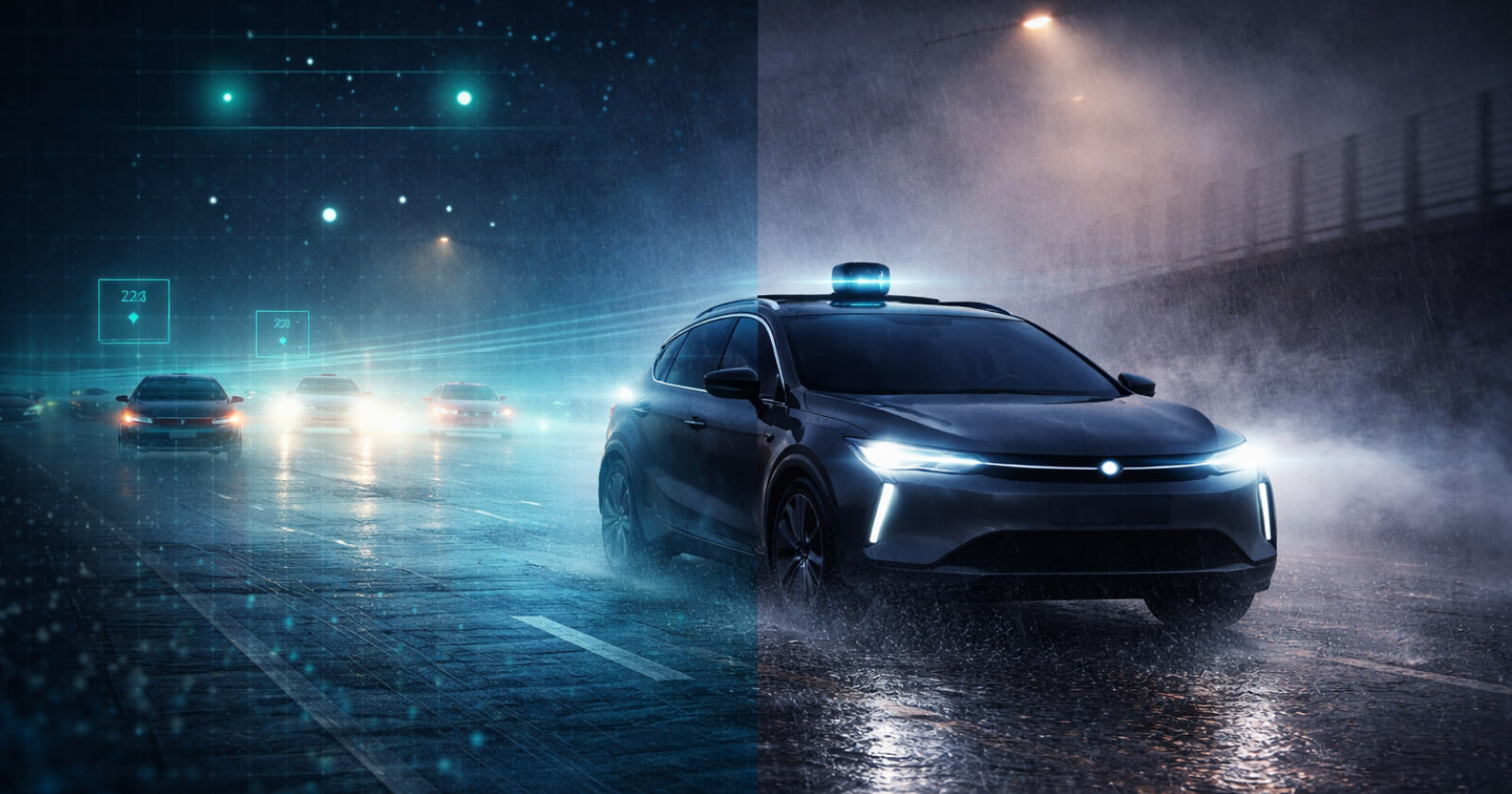
Why this matters in the real world: in highly cluttered, visually impaired scenarios, such as dust, spray, fog, or heavy rain on dark highways, camera data may be unreliable, may lack robust depth, and may miss critical obstacles. In those moments, you need sensing and reconstruction that can isolate physically plausible targets from noise and multipath artifacts. Atomic Norm-based reconstruction helps preserve resolution and improve robustness when conventional pipelines degrade. To put it into non-technical terms, it’s the difference between seeing a blurry smear and resolving distinct objects that are close together in a messy, low-visibility scene.
How do these [LLM-style] methods work together to deploy physics-informed computation efficiently across devices?
There is a real structural parallel with LLMs, but the goal is not to copy LLMs literally, it’s to borrow the reasoning architecture.
In LLMs, a model can use a chain of reasoning to move from tokens to a conclusion. In our system, we use what we call a chain of causality: we treat sensor returns as evidence, and the system reasons through what physical causes could have generated that evidence. It’s not just classifying an object, it’s checking whether the signal is consistent with a solid object moving in a physically valid way.
To make this efficient at the edge, we use physics-informed computation, including physics-constrained learning and, where appropriate, PINN-style methods, so the model does not have to learn everything from data alone. By embedding known physical structure (for example, wave behavior, propagation constraints, and causal consistency) directly into the computation, we reduce the search space, improve robustness, and increase sample efficiency.
The result is a system that can run locally with deterministic low latency, which is essential for safety-critical robotics and vehicles. In long-tail scenarios, the cloud is not a fallback, the robot has to reason correctly on-device, in real time.
How do you see the interplay of cameras, radar, and lidar… and why is radar needed?
This should not be framed as a winner-take-all sensor debate. The right architecture is complementary sensing with hierarchical redundancy.
- Cameras are excellent for semantic understanding: signs, lane markings, object appearance, and behavioral cues. But in visually impaired scenarios, such as dust, fog, spray, glare, darkness, or heavy rain on dark highways, camera data can become unreliable, lose confidence, lack robust depth, and miss critical obstacles.
- LiDAR provides strong geometric structure and precise 3D shape information, but performance and cost can become constraints depending on deployment and environmental conditions.
- Radar is uniquely valuable because it provides robust ranging and velocity information and can remain useful in conditions where optical sensors degrade.
Historically, radar’s weakness has been lower spatial clarity and instability in complex scenes. That’s exactly where physics-based reconstruction and reasoning matter. Radar wasn’t a bad sensor – it was often paired with bad math. Or put differently: the industry didn’t reject radar because physics stopped working; in many cases, they deprioritized low-fidelity radar because the reconstruction stack wasn’t good enough yet.
Tesla has absolutely pushed the industry forward by proving how powerful software, fleet learning, and end-to-end iteration can be. Our view is simply that in the long tail, especially cluttered, low-visibility, and physically ambiguous scenes, a resilient physics-based sensing layer becomes critical, in other words Radar is a must have.
So, the future is not “camera vs radar vs lidar.” It’s a sensor hierarchy, where each modality contributes what it does best, and physics-based reasoning makes the fusion more reliable.
What other sectors and use cases can this technology be deployed for?
Mobility is the most visible application, but the underlying capability is horizontal: physics-grounded perception in noisy, high-consequence environments.
That has clear relevance in:
- Agriculture robotics
A harvesting robot doesn’t just need to detect fruit. It must estimate distance, orientation, ripeness, accessibility, and occlusion; reason about lighting, wind, and clutter; and then control contact force and cutting trajectory without damaging the fruit or the plant. That is Physical AI: perception, reasoning, and action under real physics. - Construction and industrial robotics
Dust, clutter, variable lighting, dynamic obstacles, and precision task execution all create conditions where perception stability matters. - Defense
Degraded visibility, interference, uncertain environments, and high consequence of false positives/negatives all increase the importance of physics-grounded sensing. - Intelligent Transportation Systems (ITS)
Infrastructure-side sensing and monitoring require robust detection in rain, fog, glare, and dense traffic scenes.
The common denominator is this: whenever a machine has to make decisions in the real world using imperfect sensor data, the bottleneck is not just planning, it is whether the system can establish physical truth from noisy measurements.
That’s where Atomathic fits: we provide a sensing and reasoning layer designed to make autonomy more reliable in the environments where conventional perception stacks break.
Share Story