
August 2026
We’re excited to share our latest edition of Cota Insights, in which we examine trends and shifts in U.S. Early-Stage, Net New Enterprise Technology. We encourage you to explore our key insights below, along with notable updates from our portfolio companies and our research group.
View from the Top: The State of the AI Economy
As we move through 2026, AI has moved from technical promise to measurable economic activity. Revenue is increasingly supported by external customers, adoption is broadening across industries, and demand for compute is creating a capital cycle of unusual scale. Yet even as AI grows faster than prior technology waves, it remains small relative to total enterprise spending and the broader economy. In our view, that tension between rapid growth and an early starting point is the defining feature of the current market.
Demand: It’s real, big and fast
The evidence of demand is becoming harder to dismiss. AI revenues are scaling approximately three times faster than previous IT waves, while declining inference costs are unlocking new use cases and driving greater usage. This is fueling a compute supercycle, with 10x more compute, new energy generation, larger data centers, and supply struggling to keep pace. Source: Exponential View, The State of the AI Economy, June 2026.
AI could ultimately automate 25% of work tasks and raise productivity by approximately 15%
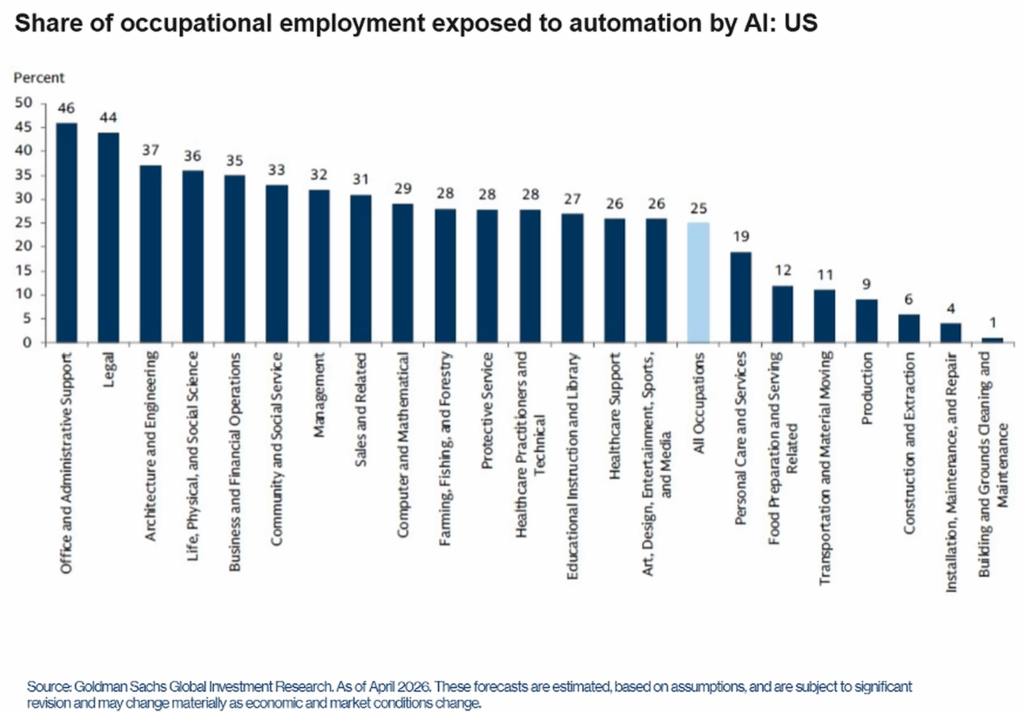
AI’s economic impact is likely to extend well beyond the technology sector. Goldman Sachs estimates that AI could automate 25% of work tasks over the next decade, particularly across knowledge-intensive and administrative functions, contributing to a potential 15% increase in productivity. We expect much of this benefit to come from streamlining workflows and reducing the cost of routine cognitive work, freeing employees to focus on judgment, creativity, and customer outcomes.
AI is scaling three times faster than any IT wave
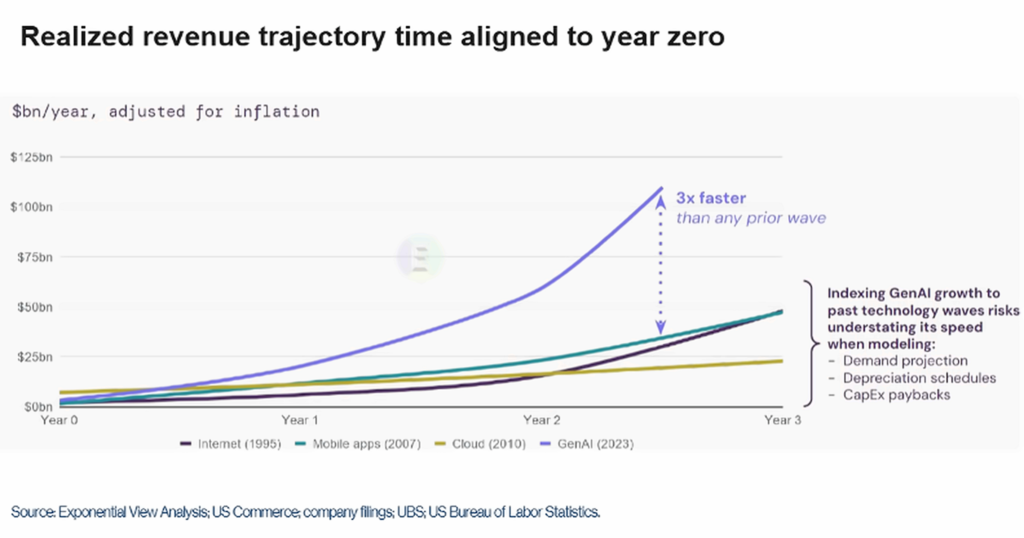
AI adoption is scaling at a pace that distinguishes it from prior technology cycles. On a time-aligned, inflation-adjusted basis, GenAI revenues have risen roughly three times faster than the internet, mobile apps, and cloud did at comparable stages of their development. This unusually steep revenue trajectory points to the speed at which demand is materializing and suggests that AI may require a different framework for thinking about demand, investment cycles, and infrastructure spending than previous IT waves
Each new $1 billion of revenue arrives faster than the last
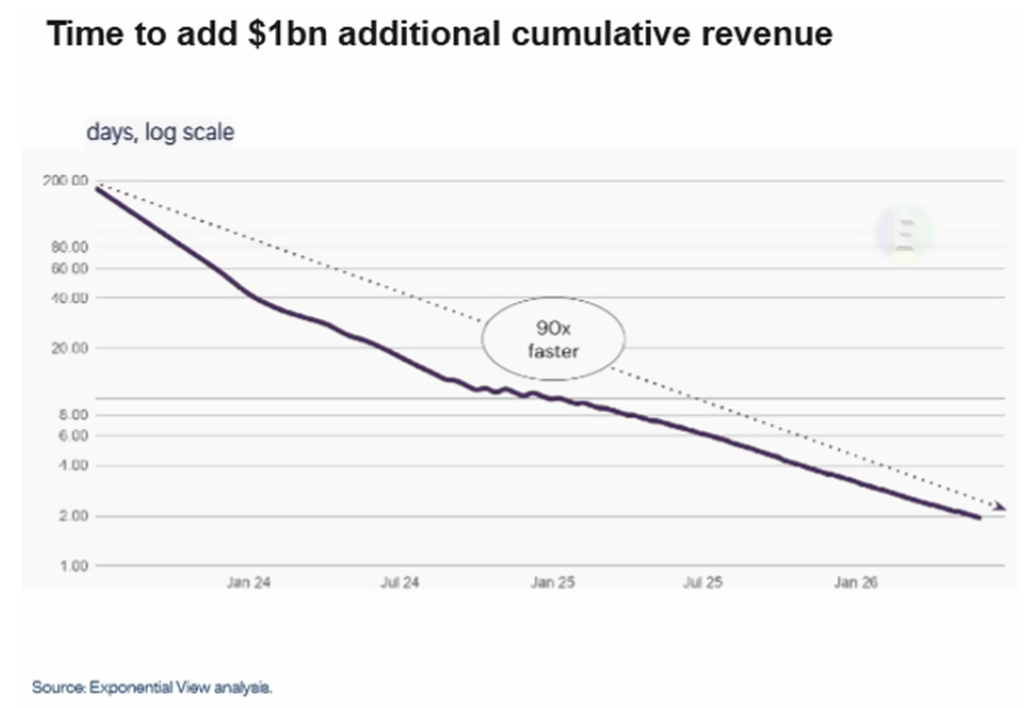
Successive revenue milestones are being reached at an accelerating pace. In 2023, the industry took roughly 180 days to add $1 billion in cumulative revenue; today, it takes less than two days, representing a 90x acceleration. This pace reinforces our view that AI is not simply a feature cycle, but a broader platform shift, with demand scaling at a rate that distinguishes it from prior technology cycles.
The economy: Big is still small, and early
Despite the pace of growth, AI remains a rounding error in the profit and loss statements of even the largest corporate spenders. Most initiatives have initially focused on efficiency and cost savings, although the mix is beginning to shift. Measured revenue may not fully capture the social gains, as consumers report benefits that are not yet reflected in the data.
The AI investment cycle is a smaller share of GDP
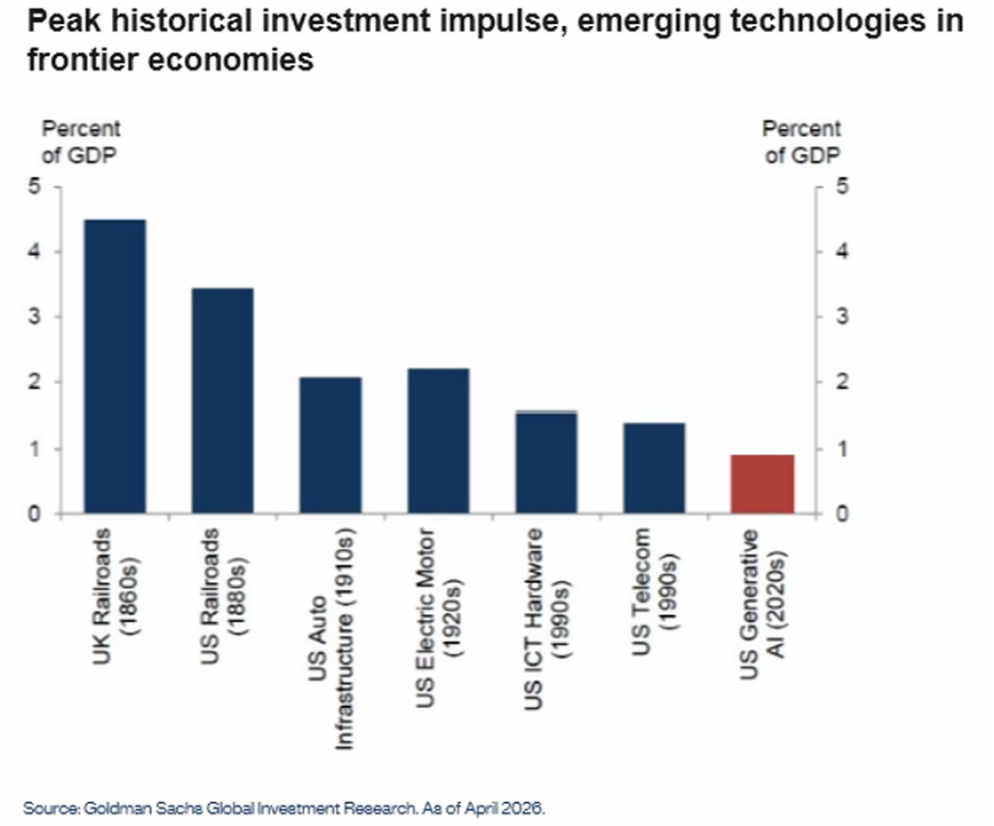
Goldman Sachs estimates that generative AI’s buildout is large in nominal dollar terms, but it remains smaller as a share of GDP than several previous general-purpose technology investment cycles. Earlier digital technologies such as telecom and ICT hardware required greater investment relative to the economy, while electric motors, auto infrastructure, and especially railroad buildouts were considerably larger. The comparison highlights that the current AI investment buildout remains modest relative to previous major technology and infrastructure cycles.
Capital expenditure: The largest buildout in technology history
Hyperscalers and neoclouds have committed roughly $2 trillion of cumulative total capital expenditure through 2026. For now, rental rates and utilization suggest that demand is absorbing much of the available supply. Growing revenue has supported the buildout, but the durability of returns will depend on how quickly infrastructure can be converted into productive token output and how efficiently that output can be monetized.
Rental rates suggest demand is absorbing existing supply
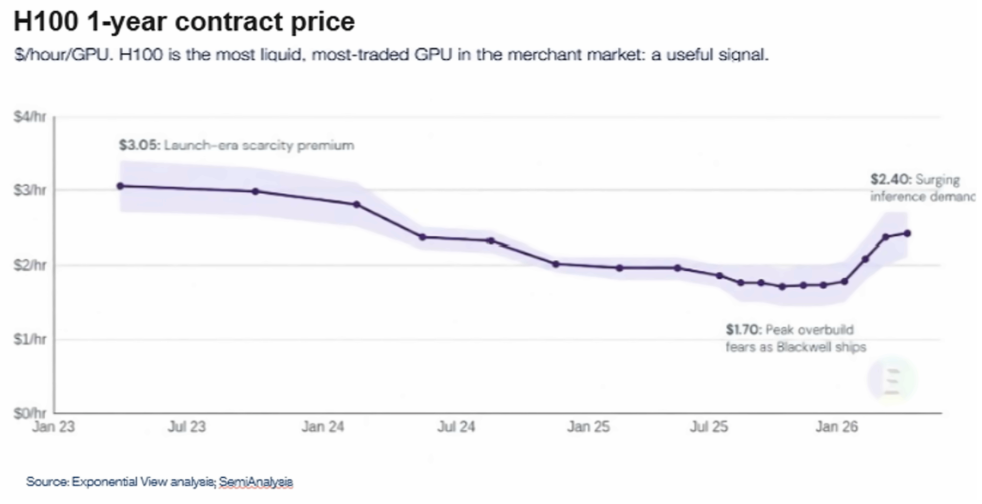
That rapid buildout is also reshaping the economics of the hardware itself. H100 contract pricing declined as supply expanded and concerns around overbuild and Blackwell displacement emerged, before turning higher more recently as inference demand surged. The rebound suggests that even as the technology cycle moves forward, demand for existing AI compute remains resilient.
Tokens: The unit of value for the AI economy?
Tokens are emerging as a practical measure of AI activity. Token volumes are growing approximately 14x annually, propelled by agentic workloads and highly elastic demand. The rise of token-based pricing makes this growth particularly relevant, while also creating an opportunity for the industry to attribute and evaluate the output generated from token consumption.
Global token volumes are growing rapidly
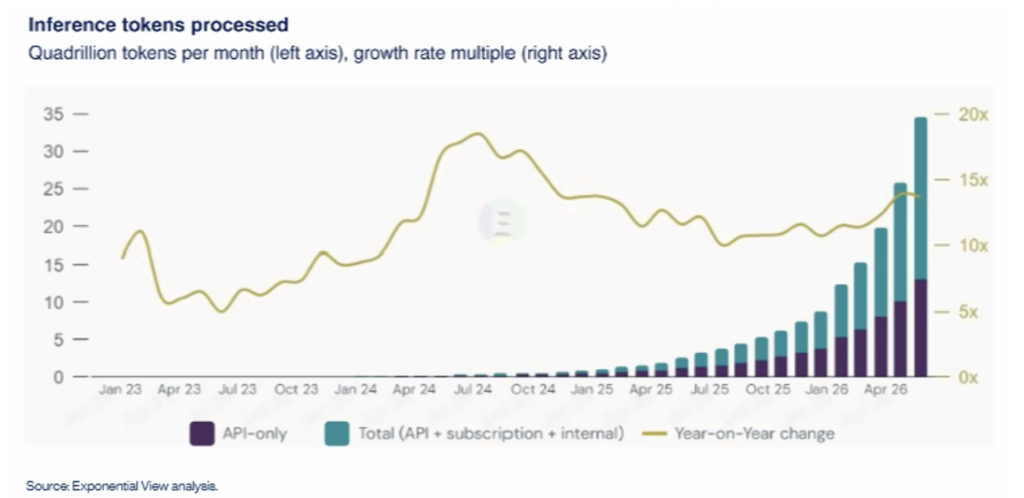
Global token volumes have risen sharply, exceeding 30 quadrillion per month by early 2026. Year-over-year growth has reached roughly 14x with total usage across API, subscription, and internal tokens continuing to increase.
The transition from chat to agents is multiplying token use
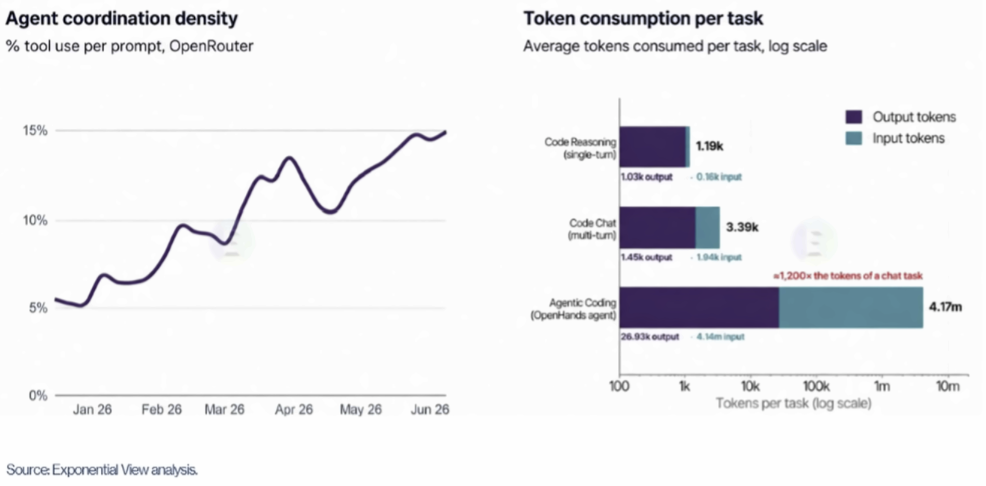
As AI use shifts from chat toward more agentic tasks, consumption rises sharply. Agent coordination becomes more prevalent while increasingly complex coding workflows require substantially more tokens than traditional chat and reasoning. This shift is driving greater token use, making the value generated per token increasingly important.
The stack: Where value is captured
AI revenue remains concentrated, but applications and models are capturing an increasing share. Infrastructure captured significant early value as compute demand outpaced available supply. As the ecosystem matures, we expect value to shift toward differentiated models, proprietary data, workflow ownership, and applications that translate AI capabilities into measurable business outcomes.
Labs must outrun open-weight commoditization to retain margin
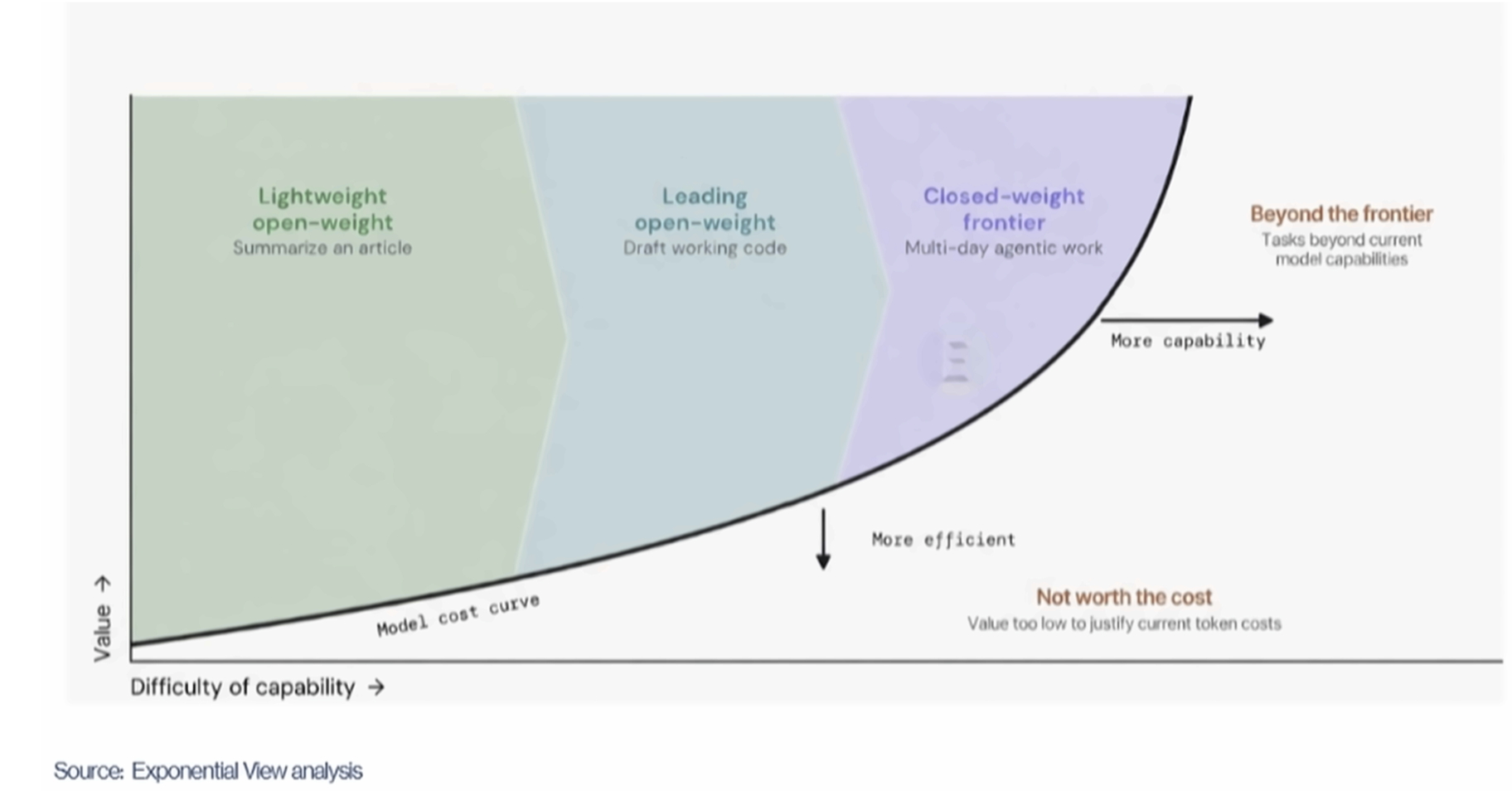
As models become more efficient, capabilities that once commanded a premium can become cheaper and more widely available through open weights. While value increases with capability, the gap between model costs and the value generated by lower complexity tasks can also widen. Labs therefore need to continue advancing the frontier to maintain differentiation and justify higher costs.
Last year’s frontier is commoditizing quickly
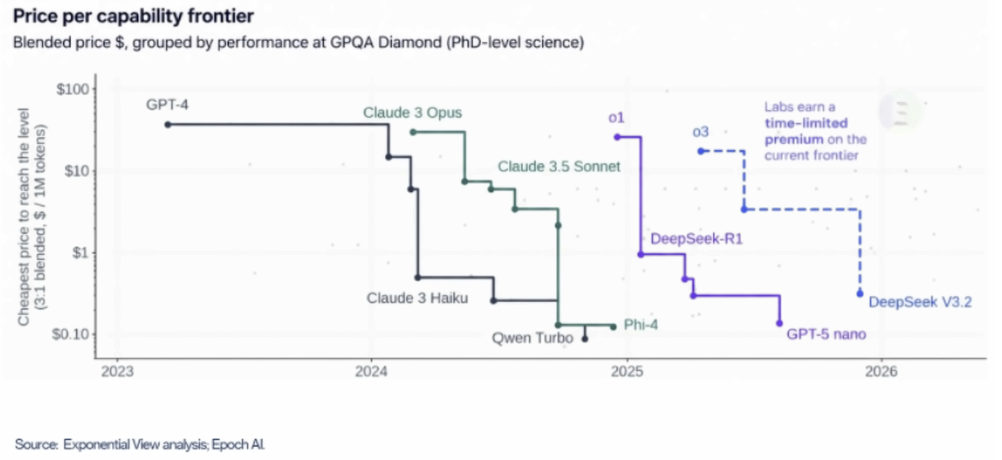
The cost of accessing frontier-level capabilities has fallen sharply as newer models reach similar performance at lower prices. This pattern is visible across successive model generations, with capabilities that once commanded a significant premium becoming available at a fraction of the cost. As the frontier moves forward, maintaining pricing power therefore depends on continuing to deliver capabilities that remain ahead of the curve.
We believe this environment reinforces the importance of a disciplined investment approach focused on companies that solve essential enterprise problems, demonstrate clear customer value, and can compound an advantage as the underlying technology becomes more capable and more widely available.
Our Portfolio Company News
Several Cota portfolio companies have achieved notable milestones that we’re excited to share:
Velaura AI, an AI compute infrastructure company developing ultra-low-power silicon and software technologies, has raised $110 million in Series A funding at a valuation exceeding $1 billion to accelerate development of its ultra-low-power AI compute platform. The company is targeting one of AI’s biggest infrastructure challenges: the growing power and thermal demands of compute across hyperscale data centers and Physical AI applications such as robotics, drones, and autonomous systems. Its Titan Core™ silicon platform is designed to deliver 2-4x better performance per watt and builds on technology already deployed in more than 30 million ASICs. The funding will support product commercialization, team expansion, and deeper partnerships with hyperscalers and Physical AI customers. LEARN MORE
Quadric, an inference engine that powers on-device AI chips, has expanded its Series C to $46 million with a second close led by the World Bank Group’s IFC, bringing total funding to $90 million. The company will use the capital to accelerate adoption of its programmable Chimera AI processor platform across automotive, AI PCs, humanoid robotics, wearables, networking, and enterprise applications, enabling customers to run evolving AI models efficiently on-device. LEARN MORE
Anaconda has acquired Kilo Code, an open-source, model-agnostic agentic engineering platform used by more than 3 million developers. The acquisition extends Anaconda’s AI-native development platform into developer IDEs and CLIs, combining Kilo’s support for 500+ AI models, self-hosting, and intelligent model selection with Anaconda’s enterprise-grade security, governance, and orchestration. The combined platform aims to help enterprises scale agentic development securely and cost-effectively from the first prompt through production. LEARN MORE
Qu, an intelligent commerce platform for enterprise QSR and fast-casual restaurant brands, launched Qu Pay, an embedded payments solution that combines payment processing, guest identity, order intelligence, and capital access within its unified restaurant commerce platform. Designed for enterprise QSR and fast-casual brands, Qu Pay turns transaction data into actionable guest insights, streamlines onboarding and reconciliation, reduces processing costs, and provides operators with faster access to working capital. The platform is already live with brands including Roy Rogers and is rolling out to additional Qu customers throughout 2026. LEARN MORE
Tote AI, a leading provider of an AI-native commerce platform for convenience retail, has partnered with Weigel’s to deploy its AI-native point-of-sale platform across all 90 of the retailer’s Tennessee locations. The cloud-based platform unifies POS, back-office, foodservice, and AI-powered store operations, helping Weigel’s streamline operations, improve employee productivity, and continuously adopt new capabilities as its business evolves. LEARN MORE
Rhombus, a leader in cloud-managed physical security, introduced its Windows Video Wall, bringing its live camera monitoring experience to Windows-based hardware. Free for Rhombus customers, the app supports scalable multi-camera and multi-monitor viewing, unattended kiosk operation, centralized configuration, automatic updates, adaptive local/cloud streaming, and enterprise-grade security. LEARN MORE
Cast AI, a leading automation platform, announced the general availability of Kimchi Coding, its autonomous multi-model coding agent designed to deliver frontier-model quality at 2.5x lower cost. Kimchi dynamically routes coding tasks across frontier and open-weight models, reducing token usage while maintaining strong code quality. Built on Cast AI’s infrastructure platform, it also provides enterprise-grade budget controls, cost visibility, data sovereignty, and flexible deployment across customer VPCs, on-prem environments, or Cast AI’s inference cloud. LEARN MORE
Our Latest Research Articles
At Cota, we are constantly exploring the intersection of technology and its broader impact on industries. Here are some of our latest research articles:
The Third Wave of Physical Intelligence
Physical AI is ushering in a new era of real-world intelligence. This article traces the evolution from digital systems of record and early computer vision to today’s AI systems that can perceive, understand, reason, and act in the physical world. The article explores why advances in vision, multimodal sensing, AI models, and edge infrastructure are enabling this shift, and how these technologies are unlocking new capabilities across manufacturing, healthcare, security, mobility, and other industries. LEARN MORE
Beyond RGB: The Wide World of Cameras
Physical AI needs more than a clear picture; it needs a multidimensional understanding of the world. This article explores the expanding camera ecosystem behind modern physical AI, from RGB and depth sensing to thermal, event-based, and spectral imaging, and how combining these modalities creates richer, more resilient perception systems for robotics, autonomous vehicles, manufacturing, defense, healthcare, and beyond. LEARN MORE
The Infrastructure Behind Agentic Memory and Execution
As AI shifts from simple chatbots to long-running agents, memory is becoming a critical infrastructure bottleneck. This article explores how agent activity translates into physical GPU capacity and why advances in storage, retrieval, context management, model serving, and observability will be essential to make agentic AI more reliable, efficient, and economically scalable. LEARN MORE
Share Story