
March 2026
As we move through 2026, we’re excited to share perspectives on the trends and shifts in U.S. Early-Stage, Net New Enterprise Technology. We encourage you to explore our key insights below, along with notable updates from our portfolio companies and our research group.
View from the Top: Key Trends and Insights
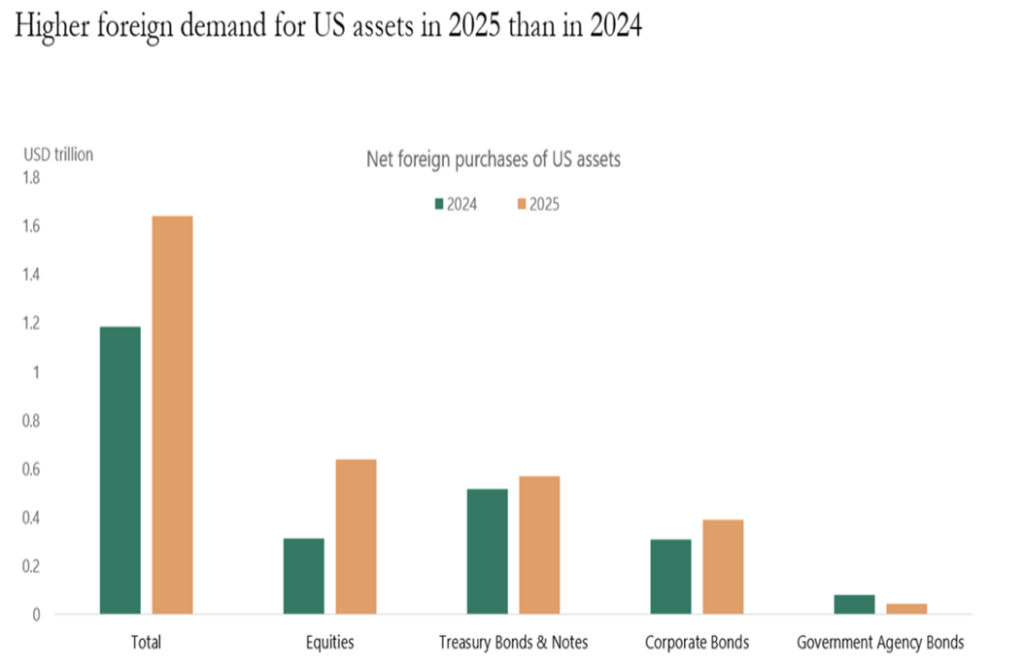
2025 Saw a Marked Increase in Demand for U.S. Assets
Source: Apollo
This chart indicates higher net foreign purchases of U.S. assets in 2025 versus 2024, with total inflows rising from roughly $1.2T to about $1.6T. The increase appears driven primarily by equities, rising from about $0.3T to roughly $0.65T, alongside a modest step up in Treasury bonds and notes and corporate bonds, while government agency bonds are slightly lower year over year.
Cross border flows are a meaningful driver of U.S. market liquidity and pricing. Strong foreign demand helps absorb new issuance in both equities and fixed income, which can support valuations, reduce the extra return investors demand for taking risk, and contribute to steadier financial conditions. The mix of inflows also matters as equity buying can reinforce public market strength, while demand for Treasuries and credit can influence yields and discount rates that underpin asset pricing more broadly.
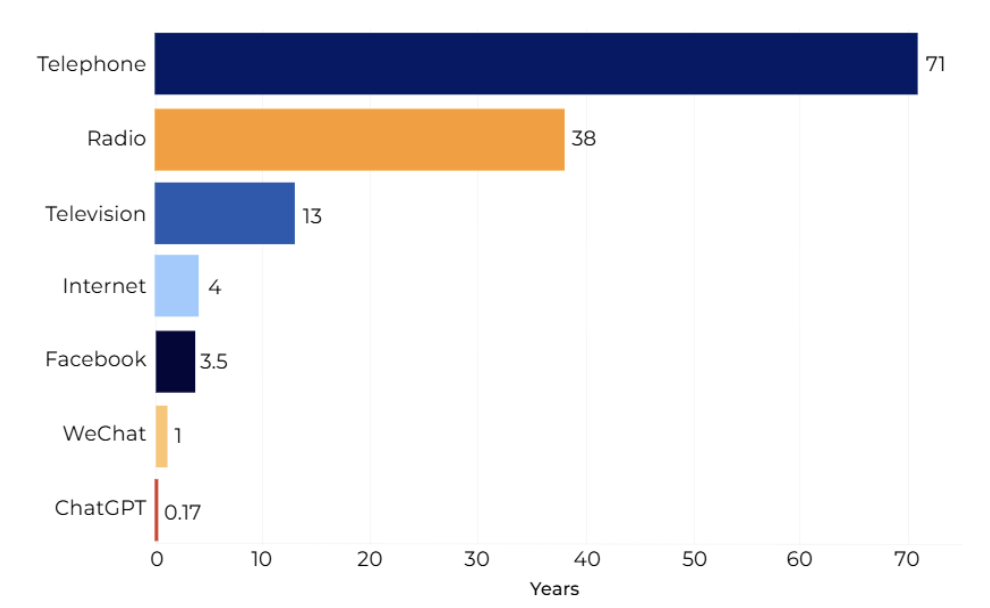
Technology Adoption Has Compressed Dramatically
Source: Scottish Mortgage Investment Trust
This chart compares how long different technologies took to reach a major adoption milestone and shows how sharply adoption timelines have compressed. Earlier technologies took decades to scale, including the telephone at 71 years and radio at 38 years, while more recent platforms scaled in a few years, such as the internet at 4 years, Facebook at 3.5 years, and WeChat at 1 year. ChatGPT stands out at roughly 0.17 years, or about two months, illustrating how quickly modern AI products can reach large user bases.
This is significant because accelerated adoption compresses the timeframe over which markets develop and competitive dynamics play out. Rapid scaling can speed up product iteration, revenue formation, and category consolidation, while also reducing the time available to establish distribution advantages, secure data access, and become embedded in core workflows. In practice, the ability to convert early usage into durable, repeatable value becomes a primary determinant of long-term outcomes.
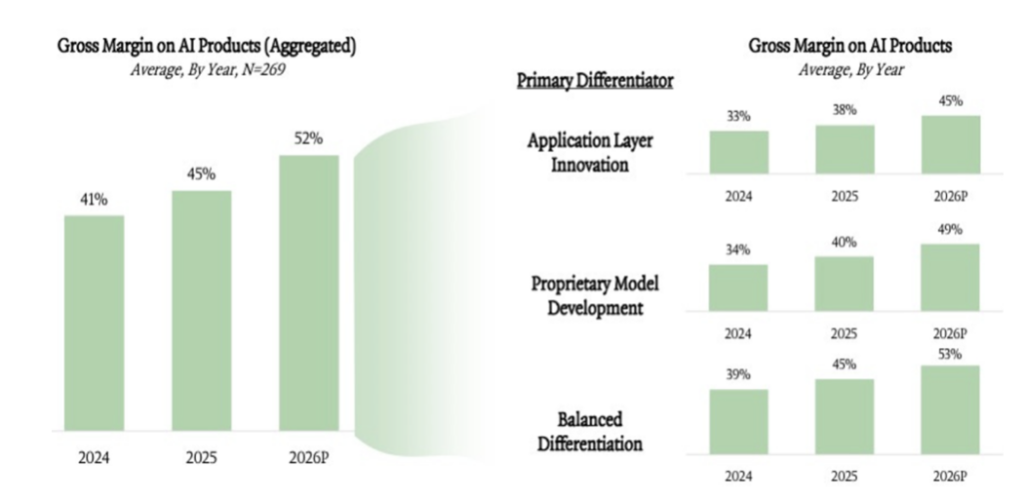
Gross Margins on AI Products Are Expanding – Signaling a Maturing Market
Source: ICONIQ Portfolio Company Survey
Gross margins across 269 AI products are expanding rapidly, rising from 41% in 2024 to 45% in 2025, with 52% projected for 2026. By primary differentiator, margins increase each year for every group. Application layer innovation rises from 33% (2024) to 38% (2025) to 45% (2026P), proprietary model development rises from 34% (2024) to 40% (2025) to 49% (2026P), and balanced differentiation leads, rising from 39% (2024) to 45% (2025) to 53% (2026P).
The message is straightforward. AI products can generate real and durable margins. The strongest performers are not relying on a single layer of differentiation but are building defensibility across the stack. As margins scale into the 50% plus range, AI businesses increasingly resemble high quality software franchises, supporting stronger cash generation, valuation durability, and more attractive long-term outcomes.
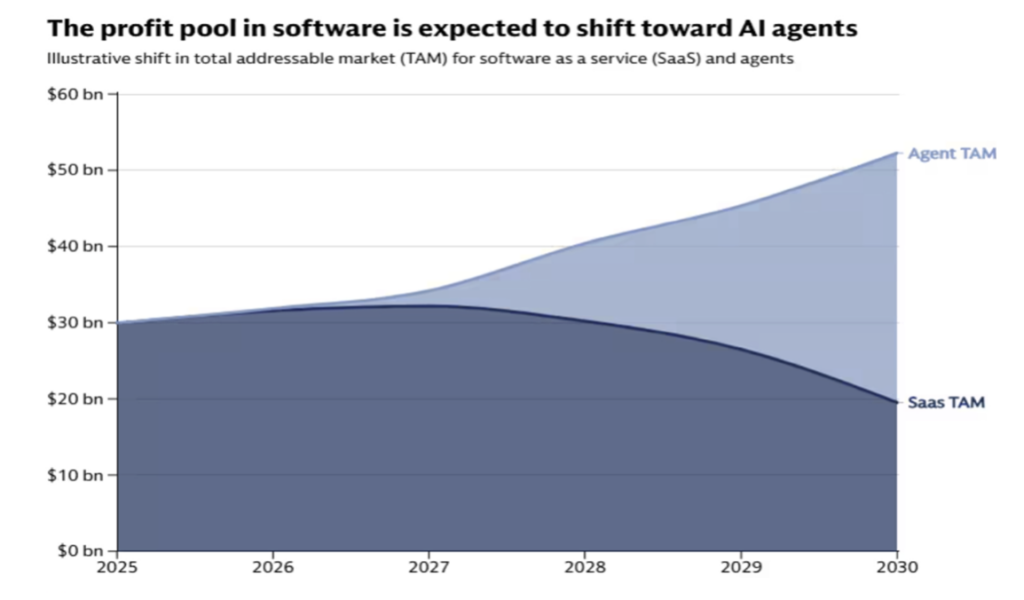
Anticipated Software Repricing as Agents Redefine the Workspace
Source: Gartner
This chart illustrates a projected reallocation of software’s total addressable market from traditional SaaS toward AI agents between 2025 and 2030. The “Agent TAM” line climbs from roughly $30bn in 2025 to just above $50bn by 2030, while the “SaaS TAM” line trends down from roughly $30bn toward ~$20bn over the same period, visually emphasizing that agents are expected to become the primary growth vector.
The key takeaway is not that SaaS disappears, but that more value is shifting toward software that can execute tasks, not just track or manage work. The chart highlights where growth is expected to concentrate, including agent driven workflows, orchestration layers that coordinate agents across systems, vertical agents built for specific functions or industries, and the infrastructure required to make agents reliable and governable. It also changes the evaluation criteria for these products. The durability of revenue depends heavily on distribution, access to the right data and permissions, and deep integration into day-to-day operations. These factors determine whether an agent becomes embedded in core workflows and can sustain adoption over time.
Our Portfolio Company News
Several Cota portfolio companies have achieved notable milestones that we’re excited to share:
CrowdStrike (NASDAQ: CRWD) announced the acquisition of Cota Capital’s portfolio company, Seraphic Security, a leader in browser runtime security. CrowdStrike will integrate Seraphic’s continuous in-session browser protection with SGNL’s continuous identity, aiming to secure every interaction from the endpoint to the browser to the cloud. LEARN MORE
CAST AI, a leading Application Performance Automation platform, announced the launch of its GPU Marketplace and that it reached a valuation of over $1 billion, after a strategic investment from Pacific Alliance Ventures (PAV), the U.S.-based corporate venture arm of Shinsegae Group, an over $50 billion Korean conglomerate with leading businesses across retail, consumer, and digital platforms. LEARN MORE
Upscale AI, a category-defining pureplay AI networking infrastructure company, announced an oversubscribed $200M Series A financing round reaching Unicorn status. With this investment, Upscale AI plans to accelerate its mission to fundamentally re-architect networking for the AI era. LEARN MORE
Qu, a leading unified commerce platform for restaurants, and Roy Rogers, the Mid-Atlantic quick-service restaurant brand, announced that Roy Rogers has selected Qu as its technology partner to modernize its ordering and kitchen operations systemwide. LEARN MORE
Simbian, building Superintelligence for Security Operations, announced the launch of the Simbian AI Pentest Agent, a new solution to provide enterprises with ongoing, on-demand penetration testing. Simbian’s AI Pentest Agent is one of the first automated penetration test solutions to incorporate business context, ensuring that findings are focused on the specific security risks and priorities of each customer. LEARN MORE
Our Latest Research Articles
The Evolving CFO Tech Stack – Owning the Logic
The modern CFO tech stack is shifting from storing data to owning logic. The key debate is whether AI intelligence should live inside applications (distributed intelligence) for workflow efficiency and context, or above them (centralized intelligence) for cross-functional, strategic insight. Distributed models offer speed but risk vendor lock-in and opaque logic. Centralized models enable holistic analysis but can lose context and require heavy maintenance. The likely future is a hybrid anchored by a semantic vault, a governance layer that standardizes metric definitions across systems. For CFOs, the priority is owning their company’s financial logic and turning it into durable institutional memory. LEARN MORE
How Stablecoins Are Changing the Future of Finance: Key Catalysts Powering the Revolution
Stablecoins are moving from crypto-native tools to mainstream financial infrastructure, entering an “Expansion Era” driven by institutional adoption and clearer regulation. Three forces are accelerating growth: regulatory clarity, real-world utility (faster, cheaper global payments and settlement), and programmable applications built on digital dollars. As banks, enterprises, and developers engage, stablecoins are emerging as a foundational payments layer, unlocking a new wave of financial applications. LEARN MORE
Share Story