By Payman Samadi, Co-Founder and CEO of Eino and Murat Kilicoglu, Partner at Cota Capital
As more industrial environments adopt automation and autonomy, the network is becoming a far more strategic part of the stack. In COTA’s recent conversation with Eino Co-Founder and CEO Payman Samadi, he explains why enterprise network planning is reaching a breaking point, and why digital twins and AI may be the tools that make it scalable again.
Q: What first drew you to networks as a problem worth building around?
Networks are one of those foundational systems people only notice when they stop working. They sit underneath everything, from the apps we use every day to industrial and commercial systems.
What stood out to us was that the market was changing in two ways at once. There were more connectivity options available than before, and at the same time, enterprises were going to need many more networks to support new AI-driven applications. That made this feel like a very important infrastructure problem.
Q: Why is network planning becoming more urgent now?
Because the number of environments that need reliable connectivity is growing quickly. In warehouses and industrial sites, you now have self-driving lift trucks, autonomous devices, inspection robots, and AI cameras, and all of them depend on some kind of network.
That means we are going to need to build a lot more networks over the next five to ten years. The problem is that doing that still depends on tools and expertise that are both hard to scale.
Q: What is not working about the current approach?
Two things: the tooling and the talent base. On the tooling side, the market is fragmented, with different tools built for different parts of the workflow or different network types. That makes it hard for enterprises to scale efficiently.
On the talent side, there is a shortage of younger people entering networking. There is a real gap between the number of networks enterprises will need and the number of specialists available to design and manage them.
Q: What makes digital twins useful in networking?
The key point is that networks serve physical spaces. Applications sit at different heights, in different locations, and under different conditions inside those spaces. If you want the network to work reliably, you need a clear understanding of the environment it is serving.
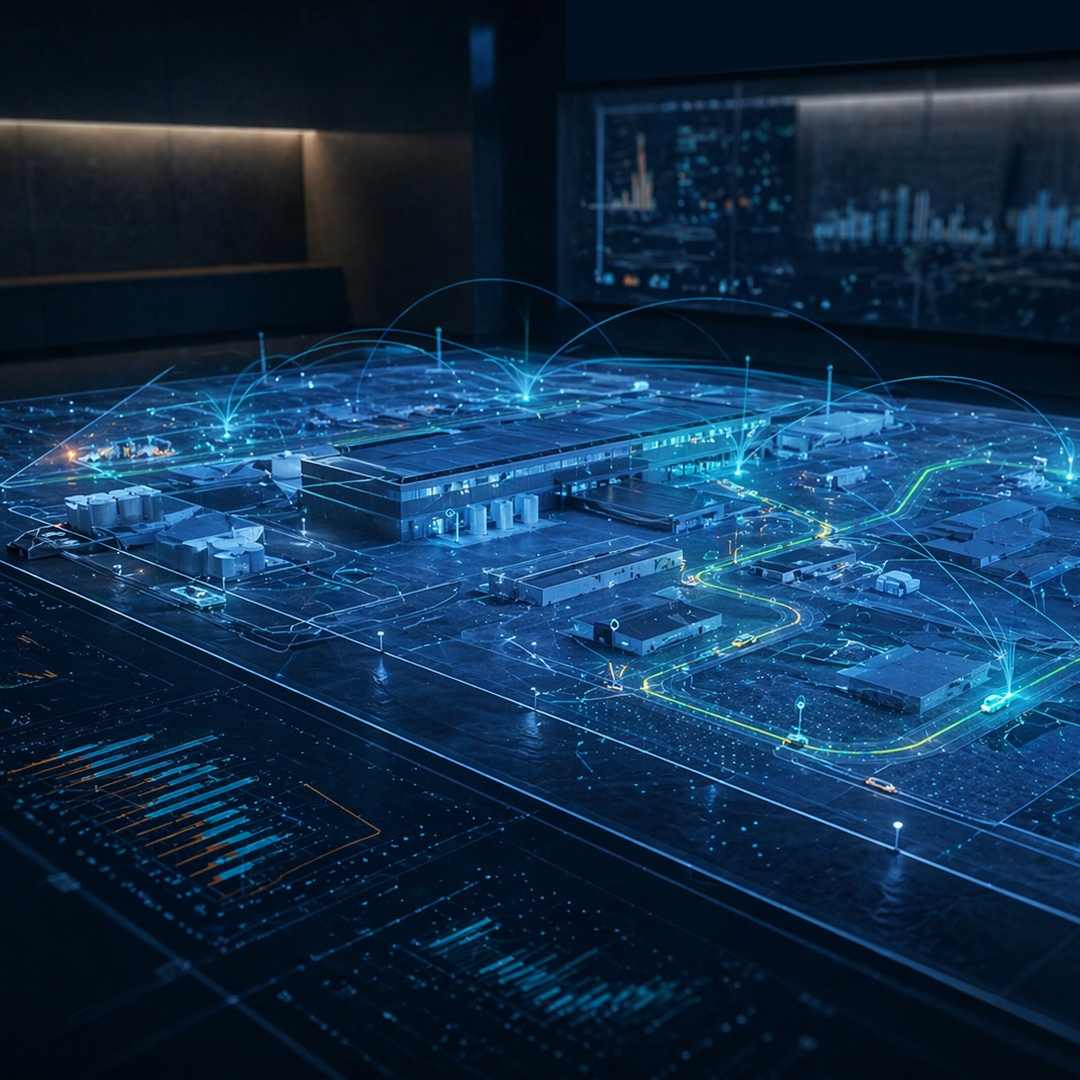
A 3D digital twin makes that easier. Instead of relying only on repeated site visits and surveys, teams can use a digital copy of the environment to design faster, troubleshoot faster, and connect network data back to the physical space where issues actually happen.
Q: How does Eino use AI inside the product?
There are several layers of AI. One is computer vision, which helps turn layouts and other inputs into 3D models. Another is automation around design decisions, such as how many radios are needed and where they should go.
On top of that, Eino has built agentic AI workflows. These agents are meant to help fill the expertise gap by understanding standards, best practices, and common workflows in network engineering.
Q: What is an example of what those agents can actually do?
One example is rough-order-of-magnitude planning. If a customer wants to understand the likely cost or radio count for a warehouse, the agent can work through that workflow, fill in missing information, and return an initial answer.
The broader idea is to let users interact with the platform through natural language rather than needing deep knowledge of every underlying workflow. Over time, the vision is that multiple agents could work together and automate much more of the overall planning process.
Q: What changes in networking as we move into Industry 5.0?
Industry 5.0 brings more autonomy and more human-machine interaction. Compared with earlier phases, it is not just about connecting static devices. It is about supporting systems that move, make decisions, and interact with people in real time.
That changes the network requirements. Latency matters more. Reliability matters more. Mobility, roaming, throughput, and security all become more important when the applications running on top of the network are more dynamic and more operationally critical.
Q: Why are self-optimizing and self-healing networks becoming more important?
Because enterprises do not want to overbuild networks for every possible peak, but they still need those networks to perform reliably for critical applications. Businesses care less about the network itself than about whether the application it supports works.
That is where self-optimizing capabilities matter. The goal is for the network to adapt to changing conditions, surface problems early, and give enterprises confidence that they can add new applications without taking on major operational risk.
Q: What kinds of data are needed to build a digital twin for a site?
The answer depends on whether the site is outdoor or indoor. Outdoors, Eino pulls together terrain, greenery, buildings, industrial infrastructure, and other environmental data from multiple providers through APIs. The hard part is turning that into a consistent scene and understanding what each object is made of, since materials and geometry affect how signals propagate.
Indoors, the starting point is often a layout or floor plan. From there, Eino uses computer vision to identify walls, doors, windows, columns, shelves, and other structures, then makes informed assumptions about things like materials and attenuation. Users can then adjust those assumptions easily if needed.
Q: Where does the ROI show up for customers?
A useful way to think about it is as a before-and-after workflow. Traditionally, getting to a rough order of magnitude for a network project could take weeks, require site visits, and depend on scarce expertise. With Eino, that initial work can happen in minutes.
That has two benefits. First, it shortens sales cycles and helps enterprises align faster internally. Second, it reduces dependence on highly specialized people who are expensive to hire and not widely available.
Q: How should customers think about speed and accuracy together?
The way to think about it is that customers can get to roughly 80% in minutes, with the remaining work happening much faster than in traditional processes. The platform is also designed to be intuitive enough that most users need only one or two hours of training, rather than lengthy certification paths.
That matters because speed alone is not enough; the workflow also has to be usable by a broader set of people.
Q: What does the longer-term vision for enterprise networking look like?
The key phrase is “zero touch.” The idea is a single platform that is agnostic to network type, geography, use case, and vendor, with AI agents continuously monitoring the network and handling different operational workloads.
In that future, agents would proactively identify likely problems, recommend remedies, and in some cases resolve issues directly, giving the user a report rather than forcing them to manage every step manually.
Q: What should network leaders be doing differently today?
The trust people now place in AI in everyday tools should start extending into enterprise workflows as well. Leaders should be more open to using AI and automation in networking, not as a threat to engineers, but as a way to empower them.
The change is less about replacement and more about enablement: better tools, faster work, and a lower barrier to keeping up with increasingly complex environments.
Closing Thoughts
What makes Eino’s thesis interesting is that it focuses on a less visible part of the AI stack. As industrial systems become more autonomous, the network becomes more consequential, and harder to plan using traditional methods.
The argument is that digital twins and AI can help close that gap by reducing manual work, compressing timelines, and making network planning more scalable for the environments that will define the next phase of enterprise automation.
Share Story