July 17, 2025
Why Digital Twins Are the Future of Industrial Operations
Type
Deep DivesContributors
Christopher Yazdani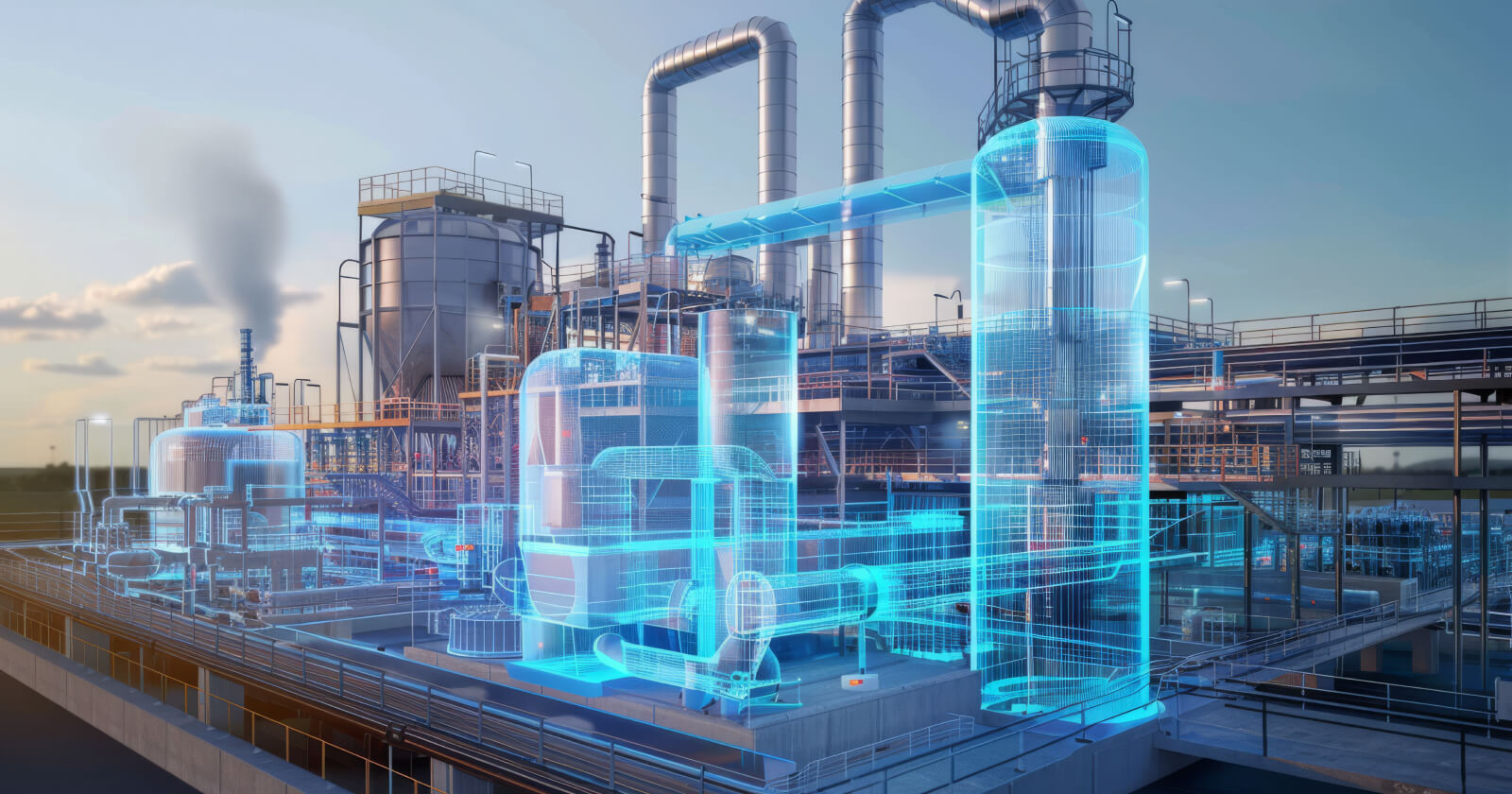
Digital twin technology is quickly accelerating into the mainstream. Analysts estimate the market at roughly $20 billion today, with projections exceeding $200 billion by 2032. Yet raw market size tells only part of the story. The true disruption lies in how virtual models are reshaping the way companies plan, decide, and act. Indeed, the physical world is now queryable in real-time, creating unprecedented operational visibility. Businesses that master this capability will set the pace across their industries for years to come.
What is a Digital Twin?
A digital twin is a high-fidelity virtual replica of a physical object or system that stays continually synchronized with its real-world counterpart. Take a jet engine, for example. The engine’s digital twin continuously pulls data from onboard sensors—tracking temperature, vibration, fuel efficiency, and more—to create an always-accurate virtual model. This allows engineers to monitor performance and anticipate maintenance needs without touching a single bolt or line of production code. Because the flow of data is bidirectional, engineers can rewind yesterday’s bottleneck, inspect the health of equipment this instant, or run a thousand “what-if” scenarios for tomorrow.
A New World of Data Mirrors
As sensor costs collapse and telemetry becomes ubiquitous, operational data that once arrived in weekly batches is now pouring in by the millisecond. Every forklift, turbine, and production line emits a continuous heartbeat that is mirrored inside its digital twin. The twin learns from every anomaly and surfaces insights before anything goes awry. The result is a fundamentally different relationship between people and the systems they run—one where the questions start with “What will happen?” rather than “What just happened?”
This revolution is already taking place in the real world. At DHL, low-cost IoT tags track forklifts, conveyors, and pallets, flooding their digital twins with millions of data points per hour. The warehouse twin renders a heat map of package flow, predicts when a motor will fail, and experiments with aisle layouts. Field teams now plan shifts around predicted demand spikes and deftly avoid dreaded downtime. Similar stories are unfolding at General Electric with gas turbines and in Formula 1 garages with car setups.
Massive Growth Ahead
Manufacturing and logistics dominated the first wave of digital twin deployments because those sectors already owned dense sensor networks and faced painful downtime costs. The second wave is gathering momentum in healthcare, energy, and the public sector, as telemetry wraps more of the physical world. Patient-level twins guide precision medicine; grid-level twins manage renewable energy fluctuations; city-scale twins balance traffic with air-quality targets.
We Are at an Inflection Point
Four technological catalysts are converging to propel digital twins from niche to industry norm:
1: IoT and Data: Industrial sensors have come way down in cost and battery-sipping protocols can now keep them online for years. Blanket instrumentation—previously reserved for the most valuable assets—has become table stakes, giving twins the granularity required for credible real-time decision making.
2: Connectivity: Modern networks deliver blazing speed and near-zero lag. This instant link between field devices and cloud systems means twins now detect issues like power surges or equipment vibrations fast enough to prevent failures. The twin is no longer a delayed reflection; it is a live conversation with reality.
3: Compute: Cloud economics have inverted the cost equation for heavy-duty simulation. Complex engineering models that once required supercomputers now run overnight on rented servers. Companies can test designs and strategies in hours—not months—turning learning velocity into a durable moat.
4: AI: Machine-learning systems have progressed from clever demonstrations to production-grade copilots. Vision models spot micro-defects on a virtual conveyor, reinforcement agents explore thousands of routing options, and language models translate sensor anomalies into plain-English alerts. AI no longer merely watches the twin; it steers, optimizes, and, in some cases, negotiates trade-offs across objectives like efficiency, resilience, and sustainability.
Why Business Leaders Care
Digital twins allow operations managers to intervene before a bearing overheats, supply-chain directors to stress-test seasonal demand spikes virtually, and product teams to optimize designs until performance targets are met. The payoff is increased uptime, leaner inventories, safer workplaces, faster innovation cycles, and a culture that treats experimentation as a daily habit rather than a quarterly gamble.
What This Means for Cota
Our investment thesis rests on two complementary opportunities. First, we look for horizontal enablers—smarter IoT devices, ultra-low-latency networks, compute advancements, and AI orchestration layers—that form the toolkit every twin builder needs. Additionally, we look for vertical specialists—teams with deep domain knowledge and proprietary feedback loops—who can tailor these tools for industries as diverse as mining, surgical robotics, and urban mobility.
Looking Ahead
As the divide between physical operations and digital systems disappears, we will start to see step-function improvements in efficiency, predictability, and margins. The winners will be those companies that leverage digital twin technology to turn data into autonomous decision-making, redefining what’s possible in their industries.
Share Story