October 14, 2026
From Electronics to Photonics: The Next Era of AI Infrastructure (Part 1)
Type
Deep DivesSara Shabani
Sara Shabani
By Sara Shabani, Senior Associate at Cota Capital
Introduction
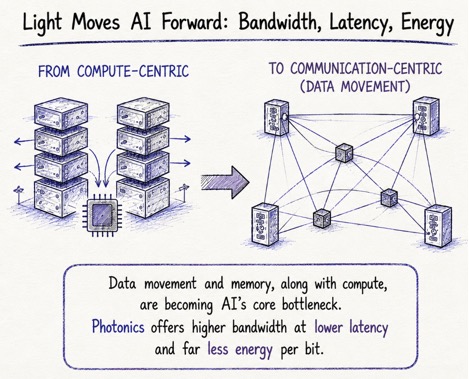
Artificial intelligence is reshaping how computing infrastructure is built. For decades, innovation was driven by making processors faster and more powerful. As AI models become larger and are distributed across thousands of chips, the challenge is no longer just computation, it is moving enormous amounts of data quickly and efficiently between processors. In today’s AI systems, data movement and memory have become a greater constraint than raw compute performance.
Photonics is attracting attention as a promising way to power the next generation of data centers. By transmitting data with light instead of electricity, optical technologies could potentially deliver significantly higher bandwidth while consuming less power than traditional copper connections. Recent advances in manufacturing, packaging, and integration have also moved photonics from a promising research area toward commercial deployment. The opportunity is not simply to replace electrical connections with optical ones, but to rethink how AI systems are designed from the ground up – from how processors access memory to the networks that connect chips, servers, and entire data centers.
We believe modern AI infrastructure is best viewed as one large, distributed computer. Its performance depends on how efficiently data flows across every level of the system: between compute and memory (scale-in), across chips within a package (scale-up), between servers and racks (scale-out), and across data center networks (scale-across). As AI continues to scale, competitive advantage may increasingly depend on building a new fabric for dramatically enhanced data movement and memory, with photonics emerging as one important enabling technology for the next generation of AI infrastructure. Historically, platform shifts occur when technology, market demand, and the ecosystem mature together; current developments in AI appear to be creating that opportunity for photonics.
Why Photonics? AI’s Next Bottleneck
Photonics moves information with light instead of electrons. Optical links carry more bandwidth at lower latency and use far less energy per bit; techniques such as dense wavelength-division multiplexing (DWDM) allow many data streams to share a single fiber simultaneously for parallelism. As AI systems continue to grow, those advantages matter more.
Based on what we are observing in the market, AI is becoming memory- and communication-bound. Training and serving frontier models mean constantly shuttling parameters, activations, gradients, and KV caches across thousands of accelerators while feeding large volumes of data from high-bandwidth memory (HBM). In much of today’s infrastructure, the limiting factor is less about how fast a GPU can compute, but how quickly it can reach and exchange data.
Additionally, photonics offers a different path. Because light avoids many of the losses baked into electrical signaling, optical interconnects can deliver much higher bandwidth at lower power over longer distances. The bigger payoff, in our view, is not only faster versions of today’s networks but also architectures that were not previously practical – optical I/O, memory disaggregation, optical switching, and, in time, photonic memory and compute.
Why Now? The Photonics Inflection Point
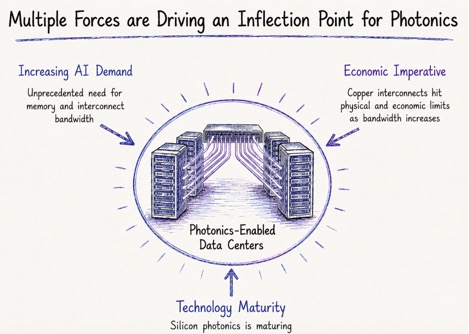
Photonics is not new; it has been around for decades. What has changed is not the underlying science but the convergence of three forces at once – AI demand, economics, and technology readiness.
First, AI is creating an unprecedented need for memory and interconnect bandwidth. As clusters scale from hundreds to tens of thousands of accelerators, moving data between chips, memory, and racks becomes as important as the compute itself. Industry roadmaps treat optical connectivity (e.g., optical I/O, optical switches) as the foundation for the next generation of AI infrastructure.
Secondly, electrical interconnects are running into both physical and economic limits. As bandwidth continues to increase, copper interconnects hit fundamental physical limits, requiring exponentially more signal processing, packaging, power, and cooling to maintain performance. The energy required to move data is no longer scaling with compute, making communication one of the fastest-growing costs in AI infrastructure. For hyperscalers investing billions of dollars in AI, improving the efficiency of data movement is becoming just as important as increasing computational throughput.
Third, the technology is finally getting mature. Silicon photonics has matured from a research platform into a proven manufacturing technology, already deployed across modern data centers. Progress in lasers, modulators, packaging, foundry processes, and testing has moved the industry focus from proving that photonics works to scaling it efficiently. The competitive edge, in our view, no longer lies in whether the technology works, but in who can manufacture, integrate, and deploy it best.
A Vision for the Next Era of AI Data Centers
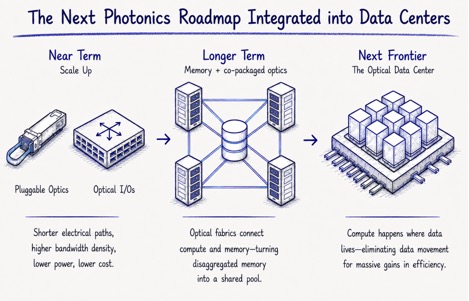
Moving optics closer to the GPU may be only the beginning. Over time, photonics could evolve from a means of moving data into a broader architectural layer that connects compute, memory, and eventually computation itself.
In the near term, the focus is on bringing optics closer to compute in scale-up. The industry is already moving from pluggable transceivers toward co-packaged optics and optical I/O, shifting the electro-optic conversion step closer to the processor. However, Copper does not disappear; electrical pathways simply become shorter, raising bandwidth density while reducing the power required to move data.
Over a longer horizon, optical connectivity could reshape the relationship between compute and memory. Optical fabrics could link accelerators to disaggregated memory pools, enabling resources to be shared across the system while reducing the latency and energy costs of data movement. At that stage, photonics becomes more than an interconnect; it begins to influence the architecture of the data center itself.
Further out lies the next frontier, where the same logic extends to computation and to what an optical data center might look like. AI workloads are highly parallel, which favors photonic architectures capable of processing many optical signals simultaneously. The ultimate aim is to bring optical communication, memory, and potentially compute into closer alignment, so that computation can happen where data already resides – at low power, high bandwidth, and low latency.
For now, the focus appears to be on a heterogeneous architecture in which electronics and photonics coexist, each deployed where its physical and economic advantages are strongest.
Share Story