June 2, 2026
Quantum and AI Superpowers: Where the Real Synergy Lies
Type
Deep DivesSara Shabani
Sara Shabani
By Sara Shabani, Senior Associate at Cota Capital
Introduction: A New Paradigm in Compute
Artificial intelligence (AI) is scaling at an unprecedented rate, but the limiting factors are no longer just model architecture or data. They are increasingly physical and economic: compute availability, energy consumption, and the cost of sustaining large-scale infrastructure, creating an opportunity for a new computing paradigm.
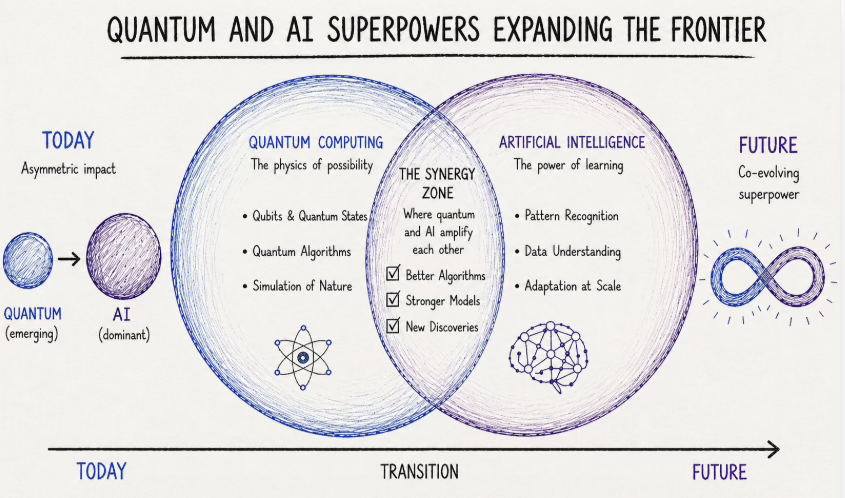
Quantum computing is still widely treated as a separate frontier: early-stage, lab-based, and disconnected from the modern AI stack. Quantum technology needs to be reframed. The right question is not whether quantum will replace AI, but where the two augment each other inside a shared compute architecture, and how quickly that convergence becomes strategically relevant for real advantage and outcome.
We should expect the synergy to remain asymmetric in the near term. AI is already enabling quantum progress today, while quantum’s impact on AI is emerging, narrow, and domain specific. The longer-term question is more fundamental: what if the endgame is not integration but co-evolution, architecture where the boundary between quantum and classical processing is defined by the problem rather than the hardware? It is the two systems accelerating each other in a loop that neither could do alone. The companies that build accordingly will define the next decade of computing.
The Tech Stack: Where the Interaction Actually Happens
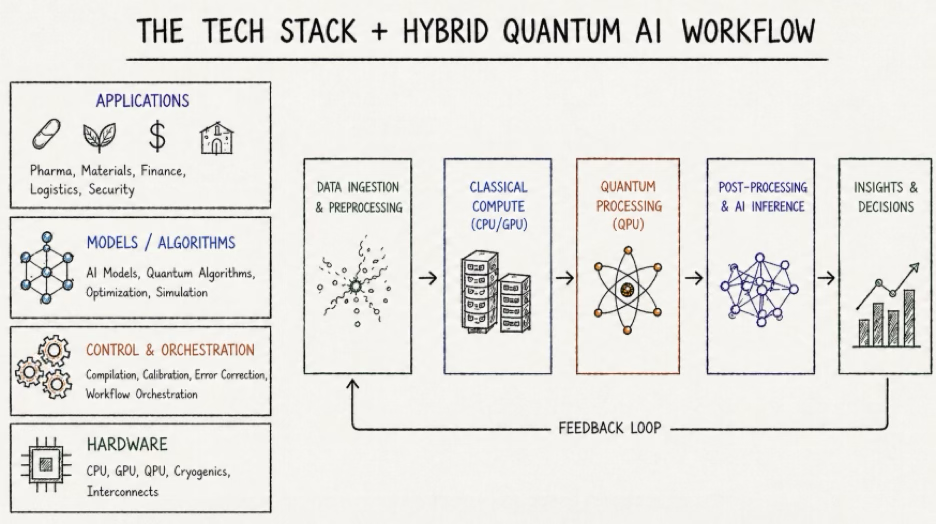
To understand where the synergy could be, it helps to look at the tech stack. At the hardware layer sit the qubits across different modalities (e.g., superconducting, trapped-ion, neutral atom, photonic), along with cryogenics and physical infrastructure. Above that, the systems and control layer handles compilation, calibration, readout, error correction, and orchestration. The algorithmic layer covers optimization, sampling, simulation, and hybrid machine learning methods. And at the top, applications span different verticals.
We believe the AI synergy today lives primarily in the algorithmic and control layers. This is where hybrid classical-quantum workflows already exist. Emerging frameworks integrating CPUs, GPUs, and QPUs into single workflows where quantum processors handle specific subroutines while classical systems orchestrate results. This hybridization is the architecture the industry is converging toward. Nvidia has increasingly framed the future of computing around hybrid quantum-classical systems integrating GPUs with quantum processors.
Closed-Loop Discovery Engine with Quantum and AI
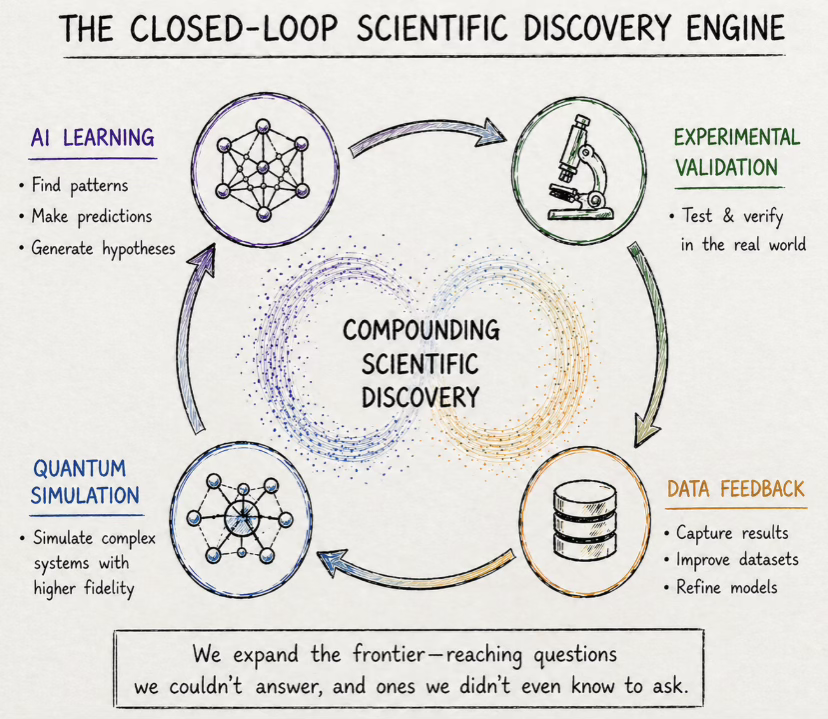
To us, the most immediate and impactful synergy is about closing the loop on scientific discovery: a flywheel of quantum simulation, AI learning, and experimental validation.
From my prior research studying strongly correlated systems during my PhD, the limitations of classical simulation became very clear. Simulating tens of electrons using traditional methodology (e.g., DFT) on classical CPUs/clusters could take hours or days, depending on the complexity of the interactions, and often failed at runtime. And that was for relatively simple systems. The dream was always to model more complex interactions in novel materials (e.g., superconductors, quantum magnetic phases), but the classical compute wall made it practically impossible. One would spend more time waiting for the simulation than thinking about the physics.
The architecture that emerges here is a closed-loop scientific discovery engine: quantum simulates at a fidelity, AI learns and identifies candidates at scale, experiments validate, and the loop compounds. Scientific discovery has historically been linear; the closed-loop model breaks that pattern entirely. It is not only faster but also opens up a new category of scientific discovery that was not accessible before.
Quantum → AI: Quantum Benefiting AI Is Narrow, Specific, But Real
Quantum does not broadly accelerate AI today, but in specific regimes, the advantages are real and worth building toward. Narrow advantages in the right problem classes have historically been the entry point for paradigm shifts.
New representations: Every major AI leap came from a new representational substrate. Quantum systems operate in Hilbert space, encoding information as probability amplitudes across exponentially many states. A 300-qubit system can represent more states than atoms in the observable universe. What if Hilbert space is the next computation representation? We may be at the same stage as the early days of neural networks: the machinery exists, but the implications are not yet legible. Researchers exploring quantum-native representations now may define the next major computational paradigm.
Optimization: The hardest AI problems reduce to optimization over non-convex landscapes where classical methods get trapped in local minima / maxima. Quantum approaches like QAOA and VQE use superposition and interference to navigate those traps. In constrained domains underpinning logistics, drug discovery, and financial modeling, this could change the searchable solution space by orders of magnitude, enabling questions previously unanswerable.
Sampling and generative modeling: Quantum naturally produce complex probability distributions difficult to simulate classically, making them relevant for generative modeling and probabilistic inference. Quantum sampling may be the first substrate architecturally aligned with how probabilistic reasoning actually operates in nature.
Machine learning on classical data: We think this is one of the most underappreciated frontiers. A small quantum computer may perform large-scale classification and dimension reduction on massive datasets using exponentially less memory than any classical machine. Validated on real tasks using fewer than 60 logical qubits, this advantage persists even with unlimited classical compute because it is rooted in a fundamental space separation rather than a runtime speedup.
AI → Quantum: How AI Is Enabling Quantum as a Force Multiplier
AI is currently the force multiplier enabling quantum systems to function at a practical scale, rather than augmenting them.
Error correction and decoding: In the noisy era of quantum systems, so-called NISQ, error correction is the gating constraint on scalable quantum computing. AI pre-decoders denoise streams and compress the problem before passing to a global decoder, simultaneously lowering error rates and reducing latency. AI also enables adaptive decoding: learning from live data rather than fixed noise models drifting from hardware. Also, error correction is not the only path to managing noise. In earlier research, I worked on engineered dissipation approaches by disturbing the environment itself. This direction remains underexplored and will likely be more relevant to AI-enabled algorithms.
Calibration and control: We think AI will become foundational in making quantum systems more controllable at scale. Quantum systems require continuous, high-fidelity tuning across thousands of parameters simultaneously. The control problem is high-dimensional and deeply sensitive to environmental noise. ML and RL methods are being applied effectively.
Algorithm and circuit discovery: AI has shifted quantum algorithm design from a craft to a scalable search problem, discovering hardware-efficient circuits in design spaces. In the NISQ regime, where noise leaves zero margin for inefficiency, this is a necessity. On the algorithm side, AI accelerates hybrid workflows like VQE and QAOA by learning better initializations and adapting in real time to hardware constraints. The result is an algorithm discovery that co-evolves with the hardware it runs on. That was not possible before.
Materials and device discovery: AI is accelerating progress in quantum materials and qubit coherence times. In my view, the bottleneck was never scientific vision, but the time and cost of classical simulation. AI is collapsing that bottleneck; better materials / devices mean better qubits, and faster progress toward fault tolerance.
Security: AI has become both a defensive and an offensive force in cybersecurity, enabling AI-driven threat detection and automated attack response. At the same time, the approach of “Q-Day,” when quantum computers could break encryption standards such as RSA and ECC, is accelerating the shift toward post-quantum cryptography (PQC) and quantum key distribution (QKD). Together, AI and quantum technologies could shape a new paradigm in cyber resilience through hybrid classical-quantum systems that continuously adapt defenses and protect critical infrastructure against both classical and quantum-era threats.
Where We Think the Market is Heading
We need to reimagine the framing in the quantum ecosystem, instead of searching for a “winning” qubit modality, where the most debate is today. The real opportunity lies in emerging architectures where quantum and AI evolve together. For researchers, the most exciting work is no longer happening at the qubit level alone. It is happening at the boundary where quantum and classical systems meet. Currently, capital is concentrating on quantum hardware as the end goal, while the infrastructure on hybrid architectures, AI-enabled control systems, and orchestration layers is relatively underserved. These are not interim layers; they are the foundation on which everything else will be built and commercialized. The companies worth backing are not just integrating, they are building for co-evolution, designing architectures that treat quantum as a native layer of future compute alongside AI infrastructure.
Share Story