
June 2026
We’re excited to share our latest edition of Cota Insights, in which we examine trends and shifts in U.S. Early-Stage, Net New Enterprise Technology. We encourage you to explore our key insights below, along with notable updates from our portfolio companies and our research group.
View from the Top: The Growth Backdrop
As we move through 2026, structural forces are converging to reshape enterprise technology, including slower global growth, a fragmenting economic order, shifting demographics, and rapid advances in AI and technology sovereignty. These forces are unfolding simultaneously, and their interaction is, in our view, the central challenge for technology investors.
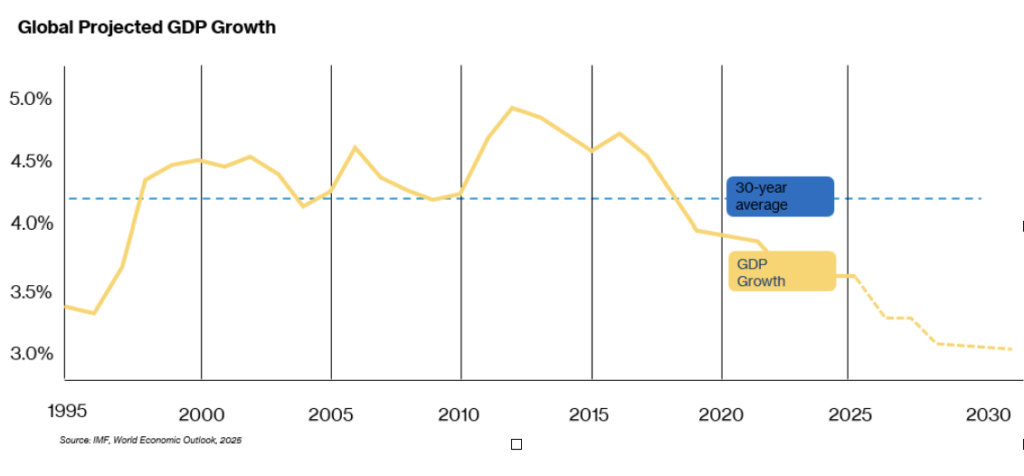
The IMF projects the next five years will see the lowest global GDP growth in three decades, well below long-term averages, as cheap capital, trade expansion, and globalization fade. We believe the era of cheap capital is over. The key exception is generative AI, which Goldman Sachs estimates could lift U.S. GDP growth from ~1.9% to ~3.0% by 2034 through productivity gains, offsetting weak growth by reducing the cost of cognitive work and accelerating R&D.
Pivoting to a world of resilience and security
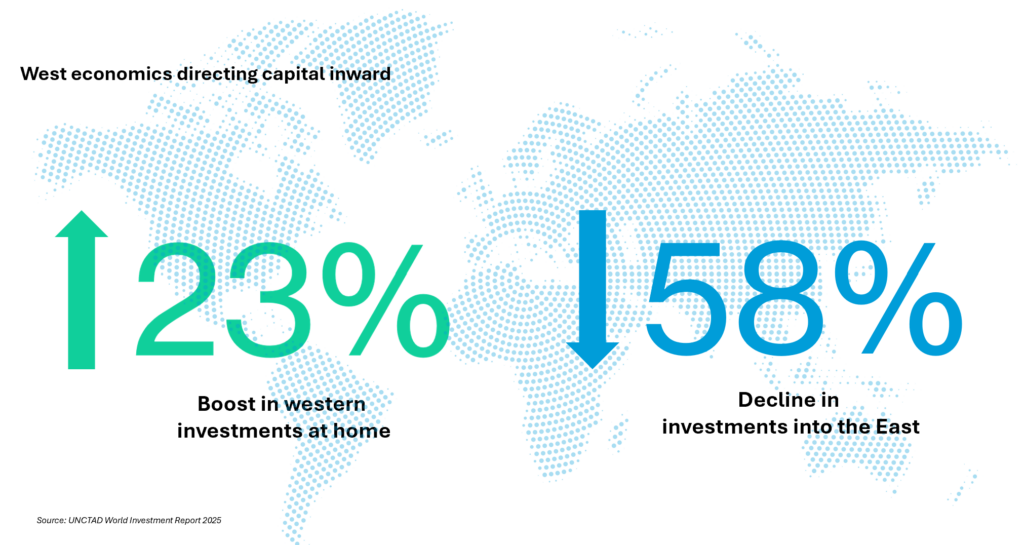
The growth outlook is inseparable from the restructuring of the global economy. According to UNCTAD, U.S.-focused investment has risen roughly 23% while flows to Eastern economies have fallen 58%. This is not a cyclical shift but a structural realignment toward resilience, national security, and supply chain control that will shape capital allocation for years to come.
Share of advanced semiconductor foundry capacity
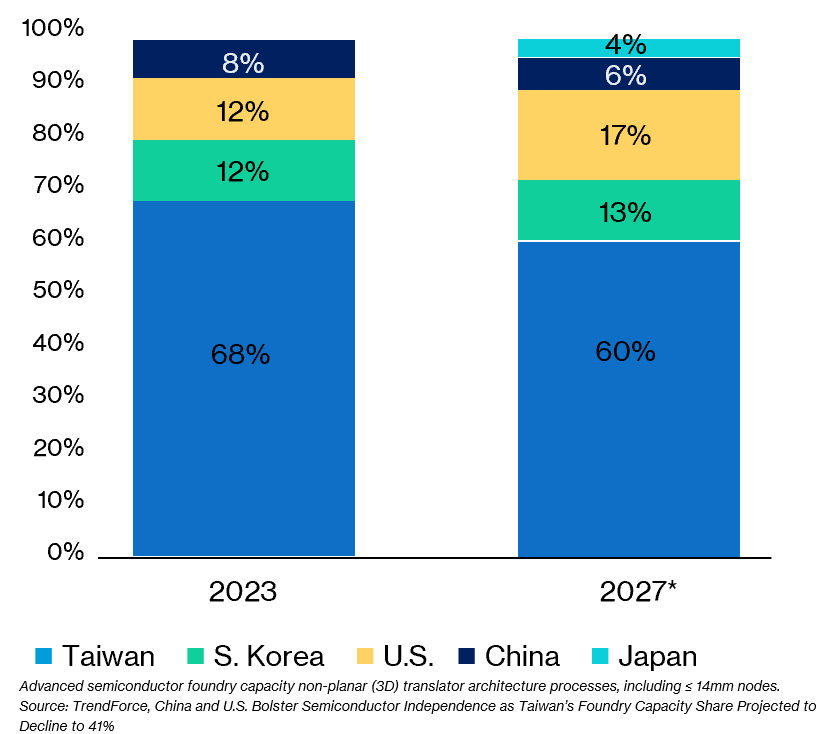
This shift is most visible in semiconductors, where advanced chips have become a strategic resource akin to oil in the 20th century. TrendForce estimates Taiwan controls ~68% of advanced foundry capacity, a concentration seen as a vulnerability by both the U.S. and China. Through the CHIPS Act, the U.S. has committed $52B to raise its share from 12% to ~17% by 2027, highlighting the scale of the self-sufficiency push.
Fewer births and longer lives drive aging population
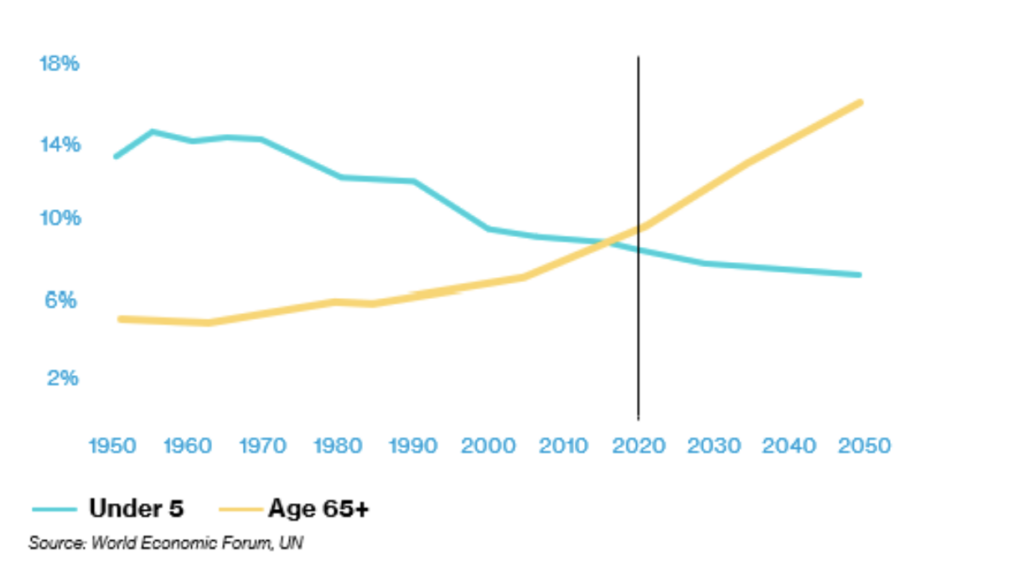
According to the World Economic Forum, 2020 was the first year people aged 60+ outnumbered children under five globally. As populations age, healthcare systems face growing strain and a historic wealth transfer is underway. With fewer workers supporting more retirees, productivity gains are becoming essential, making AI and automation key drivers of future economic growth and enterprise technology demand.
The acceleration of AI capability
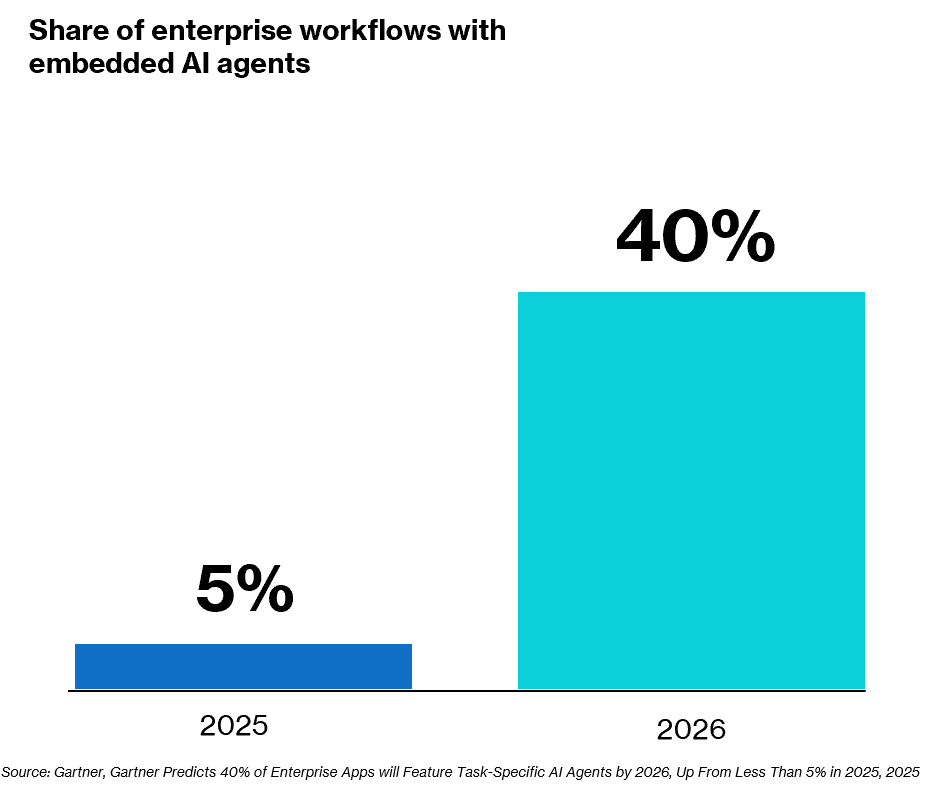
AI is advancing faster than expected, with scaling extending to inference as additional reasoning-time compute improves performance. Gartner projects AI agents will expand from ~5% of enterprise workflows in 2025 to ~40% by 2026, generating ~$450B in enterprise software revenue by 2035. Rising compute intensity and shifting hyperscaler economics are driving an AI-native, agent-first stack and major infrastructure investment, with NVIDIA AI rack power rising from ~10 kW in 2020 to >600 kW by 2027.
Hyperscaler revenue keeps growing, free cash flow is plummeting
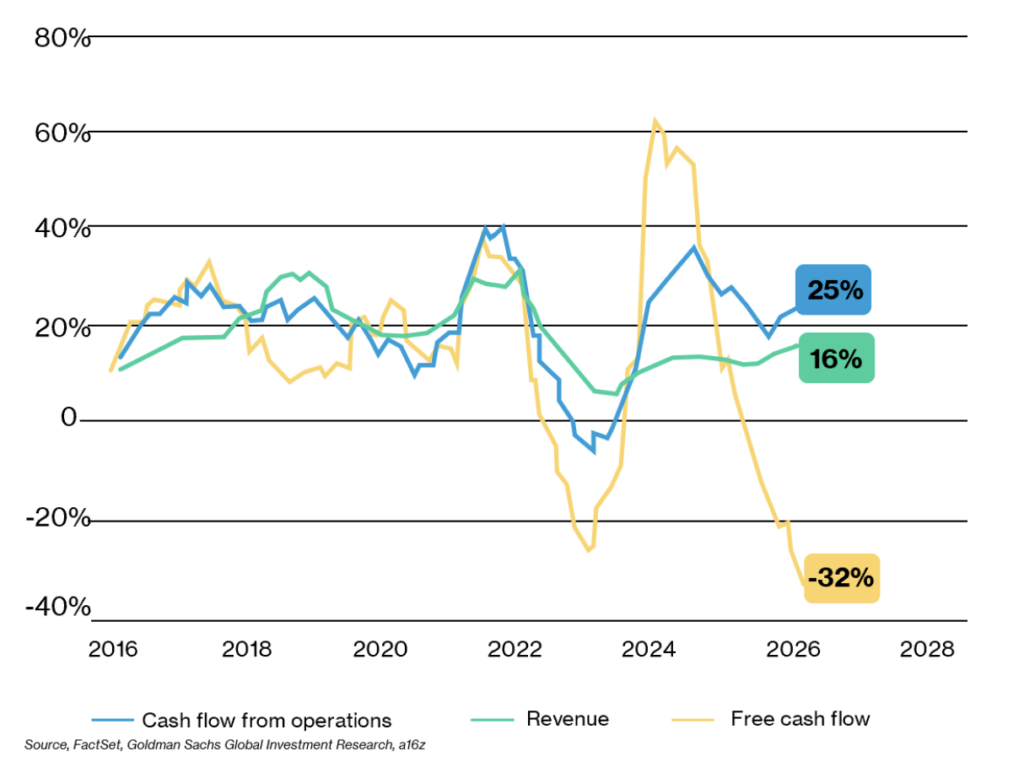
Hyperscalers are seeing strong YoY revenue growth but weakening free cash flow as AI-driven capex and capital intensity rise. Capability gains are increasingly tied to large-scale infrastructure, with frontier models hitting new highs on benchmarks like Humanity’s Last Exam.
Enterprise software is undergoing a trillion-dollar re-platforming as core systems (CRM, ERP, HRIS, etc.) are rebuilt on AI-native architectures. This shift is driven by three regimes: compounding loops where each interaction improves future decisions, context graphs that store decisions and their rationale as institutional memory, and memory scaling where organizations accumulate proprietary, usage-driven knowledge. Together, these transform enterprise software from systems of record into systems of intelligence.
Stacking scaling laws
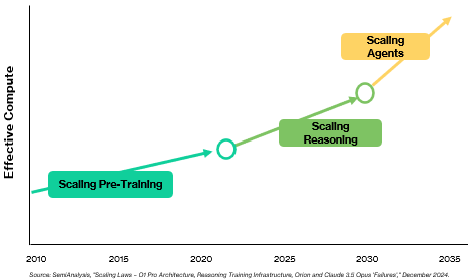
Scaling laws drive continuous AI improvement by increasing effective compute over time. There has been a shift from pre-training to reasoning and now to agent-based scaling, each unlocking greater capability and efficiency. Together, these stages highlight a compounding trajectory where more compute and better methods accelerate overall system performance.
AI moves into the physical world
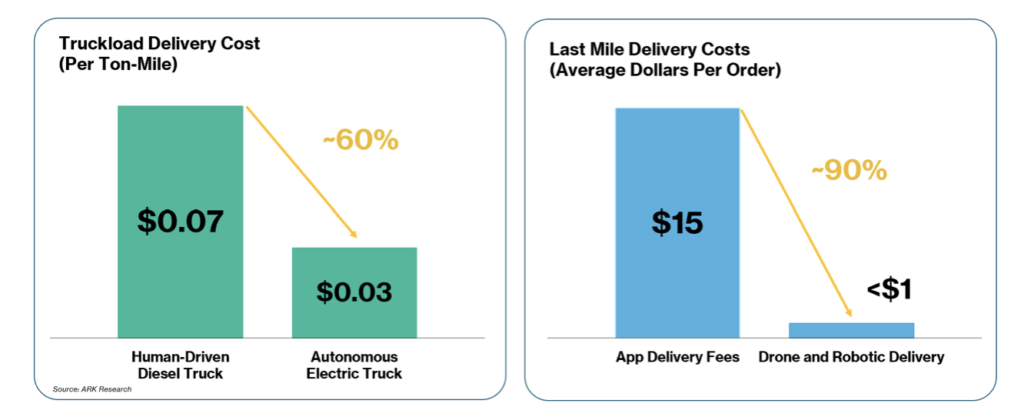
AI is extending into the physical world through advances in vision, robotics, edge computing, and simulation, and autonomous machines are set to meaningfully reduce supply chain delivery costs. Autonomous delivery is already scaling with millions of drone and robot deliveries and hundreds of millions of autonomous trucking miles. ARK estimates this could reshape logistics, with autonomous trucking cutting freight costs by ~60% and last-mile delivery falling nearly 90%, from ~$15 per order to under $1.
The energy constraint
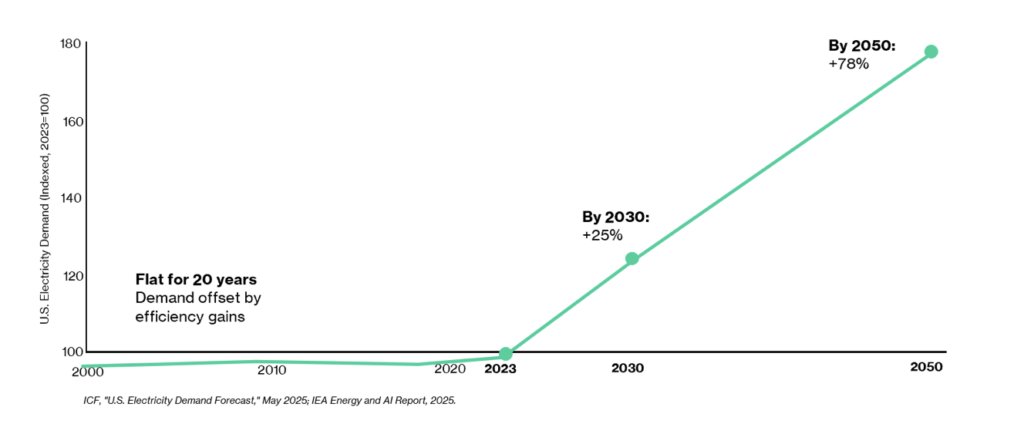
AI deployment is driving a surge in energy demand. After two decades of flat electricity use, AI data centers are projected to account for ~4.4%–12% of U.S. power demand by 2028. Combined with electrification and reshoring, U.S. electricity demand is expected to rise ~25% by 2030 and ~78% by 2050.
Electrification is accelerating across electric mobility, with the IEA reporting that 1 in 4 vehicles sold in 2025 is electric and EV sales growing ~20% YoY, with 71% produced in China. Together, these trends highlight the capital intensity of the AI buildout and the growing importance of energy infrastructure as a constraint on deployment speed.
The competitive dimension: China’s R&D position
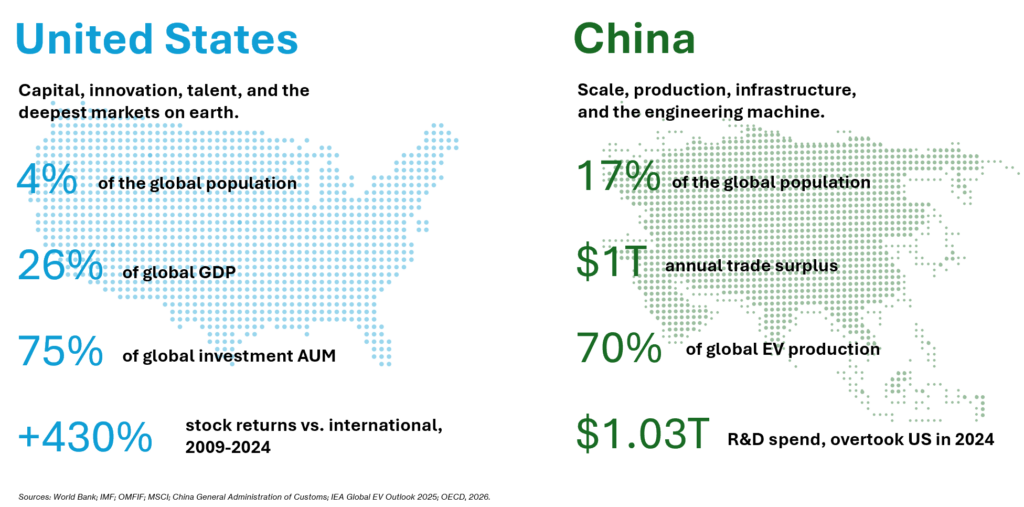
Energy and semiconductor dynamics are further amplified by shifting global R&D investment. China surpassed the U.S. in gross R&D spending in 2024 (~$1.03T vs ~$1.01T), has grown faster since 2007, and has a larger STEM pipeline and ~50% of global AI researchers. These trends don’t imply near-term U.S. loss of leadership but challenge assumptions of durable dominance in talent and research, with long-term AI advantage accruing to systems that compound learning across software, infrastructure, and real-world deployment.
Our Portfolio Company News
Several Cota portfolio companies have achieved notable milestones that we’re excited to share:
Farther, an Intelligent Wealth Management company, announced it has raised $150 million in Series D funding led by General Atlantic, a leading global investor, with participation from existing investors. With this Series D funding, Farther anticipates continued expansion of its platform capabilities and further innovation to better support advisors and clients, leveraging General Atlantic’s global wealth management investing experience and track record of scaling high-growth financial services platforms. LEARN MORE
Current, a consumer fintech platform helping everyday Americans improve their financial lives, announced an $80 million Series E equity financing at a $1.5 billion valuation. The financing comes as Current enters its third consecutive year of growth exceeding 70%. LEARN MORE
CAST AI, a leading automation platform, announced that OpsPilot, its AI agent for DevOps and SRE, is now managing workload optimization autonomously – a breakthrough in Kubernetes workload management that eliminates the need for manual tuning entirely. LEARN MORE
Qu, a leading provider of a unified commerce platform for quick-service and fast-casual restaurants, announced a new stage in its evolution: the Intelligent Commerce Platform (ICP). Unlike other AI offerings that simply add a layer on top of disconnected systems, ICP embeds native intelligence directly in the store, at the edge, and across every order within its unified commerce infrastructure. LEARN MORE
Eino, an innovator in AI-native network planning, design, and monitoring, introduced Agentic Network Observability for enterprises managing multiple network technologies and mission-critical operations. Using a 3D Digital Twin of the physical environment, Eino delivers real-time insights across wireless networks, whether deployed independently or together. The platform enables enterprises, service providers, and channel partners to design, monitor, and troubleshoot networks up to 90% faster than traditional solutions, improving performance, reliability, and incident resolution. LEARN MORE
Simbian, a self-improving SecOps company, announced formation of the Simbian Research Lab and released the Simbian Cyber Defense Benchmark to test large language models (LLMs) on detecting MITRE ATT&CK chains in complex realistic scenarios. Simbian’s Cyber Defense Benchmark is the first to use real attack telemetry in an agentic investigation format. LEARN MORE
Our Latest Research Articles
At Cota, we are constantly exploring the intersection of technology and its broader impact on industries. Here are some of our latest research articles:
From Pixels to Physics: Why VLAs Are the Critical Bridge to Physical AI
AI can now see and understand the world with remarkable sophistication. But understanding and action are not the same thing. Vision-Language Models (VLMs) can interpret scenes and follow instructions, yet they lack the physical intuition required to manipulate objects in the real world. Vision-Language-Action (VLA) models bridge that gap, combining semantic understanding with learned motor behavior to turn perception into action. In this deep dive, we explore why VLAs are emerging as the foundational architecture for Physical AI, and what it will take for robots to operate reliably in the real world. LEARN MORE
Industrial AI: What It Is and Why It’s Now (Finally) Transforming the Factory Floor
Factory floors may not look like the front lines of innovation, but a major transformation is underway. After decades of digitization, data collection, and incremental automation, Industrial AI is emerging as the intelligence layer that can turn connected factories into truly autonomous operations. In this analysis, we take a closer look at the evolution of Industrial AI, why it took decades to mature, and why its moment has finally arrived. LEARN MORE
AI Infrastructure Has a Utilization Problem
For years, AI infrastructure was a simple game: get GPUs and win. That era is ending. As hardware becomes more available, a new challenge is emerging: utilization. Why do some AI clusters deliver outsized performance while others become expensive, underused assets? The answer lies in everything around the GPU – from memory and networking to scheduling and coordination. This article explores why the next generation of AI infrastructure winners may be defined not by access to compute, but by how efficiently they put it to work. LEARN MORE
Quantum and AI Superpowers: Where the Real Synergy Lies
The next breakthrough in AI may not come from a bigger model, but from an entirely new computing paradigm. As energy, infrastructure, and scaling constraints mount, a new question is emerging: what happens when AI and quantum computing begin to work together? This piece examines why the biggest opportunities may lie not in quantum or AI alone, but at their intersection – from accelerating scientific discovery to building the hybrid architectures that could define the next era of computing. LEARN MORE
Share Story